Mandala Tattoo Meaning: The Diagram and the Decoration
LOT 20261001 · NO 21/43 · 767 WORDS · 3 MIN
A circle built out from a centre. In Buddhist and Hindu practice it maps a sacred space; the wholeness reading most tattoos carry comes from Carl Jung.
Two different things share one word
Mandala is Sanskrit for circle. In Hindu and Buddhist practice it is a diagram: a picture of a sacred space, often of a deity’s palace and the universe around it, laid out from a centre and used in ritual and meditation. In tattooing the same word mostly means something else, a round pattern of petals, dots and rings built outward from a middle point.
Both are real and both are worth wearing. They are different enough that it helps to know which one you are asking for, because the meaning people attach to each comes from a different place.
What the old traditions carry
A map of a sacred space. A Tibetan Buddhist mandala is a square palace with a gate in the middle of each side, set inside circles and with a deity or a symbol at the centre. Meditating on it is meant to move the mind from the edge to the centre. Hindu yantras work in a similar way, with geometry in place of figures.
Letting go. Tibetan monks build some mandalas from coloured sand over several days and then sweep them away and pour the sand into running water. The point is that nothing lasts. It is one of the few cases where the most famous fact about a symbol is also among the oldest.
The lotus at the centre. Many Buddhist mandalas are built around a lotus, which is why the two keep turning up together in tattoos. The lotus has its own page on this site.
The readings that came later
Wholeness and balance. This is the meaning most mandala tattoos carry, and it comes mostly from Carl Jung. In the early twentieth century he drew circular patterns himself, found the same shape in his patients’ drawings, and wrote that the mandala stands for the whole self. It is a good reading and about a hundred years old, which is young next to the diagrams it borrowed the name from.
The decorative rosette. The petal-and-dot mandala most people picture owes as much to henna patterns, lace and the adult colouring books of the 2010s as to any temple. None of that makes it less beautiful. It does mean the decorative version has no fixed meaning of its own beyond what Jung’s reading gave it.
Colours, petal counts and placement meanings. Petal counts do mean something in one place: the yogic drawings of the body’s energy centres, where each centre is a lotus with a set number of petals. Outside that system, the lists that give each number, colour or body part its own meaning are recent and copied from one another.
If you want the traditional kind
A copy of a specific ritual mandala, with its deities, its square palace and its four gates, is a religious object to the people who make and use it. Wearing one is not forbidden to anyone, but it is worth knowing what the one you have chosen is and what it is for. Images of deities on the feet or lower legs are where people from those traditions are most likely to take offence.
Most people asking for a mandala tattoo want the decorative kind. That is a perfectly good thing to want, and it is fine to say so.
How to choose which reading is yours
Say what it means to you before it goes on. “It is about balance” is a real answer, and so is “I like how a circle sits on the body”. If you want the circle to carry something specific, the centre is where to put it: a lotus, a sun, a moon, an eye or a flower that is yours. Everything around the centre is pattern.
What it is like to sit for one
A mandala lives or dies on its symmetry, so it wants a place where a circle is seen straight on: the sternum, the upper back, the shoulder cap, the back of the hand, the kneecap or the point of the elbow. On the side of a forearm or a calf a full circle bends out of view, which is why the half mandala exists.
The elbow, kneecap and sternum are near the sharp end of the pain chart. Dotwork is slow, because every shade is built from single dots, so a palm-sized stippled mandala is a longer session than its size suggests. Dots soften over the years more than solid lines do, and a mandala drawn with some open space between its rings ages better than one packed to the edge.
Mandala designs from the gallery: a lotus centre, the flower of life, a half mandala for the forearm, a botanical ring, and two placed where a circle sits flat.
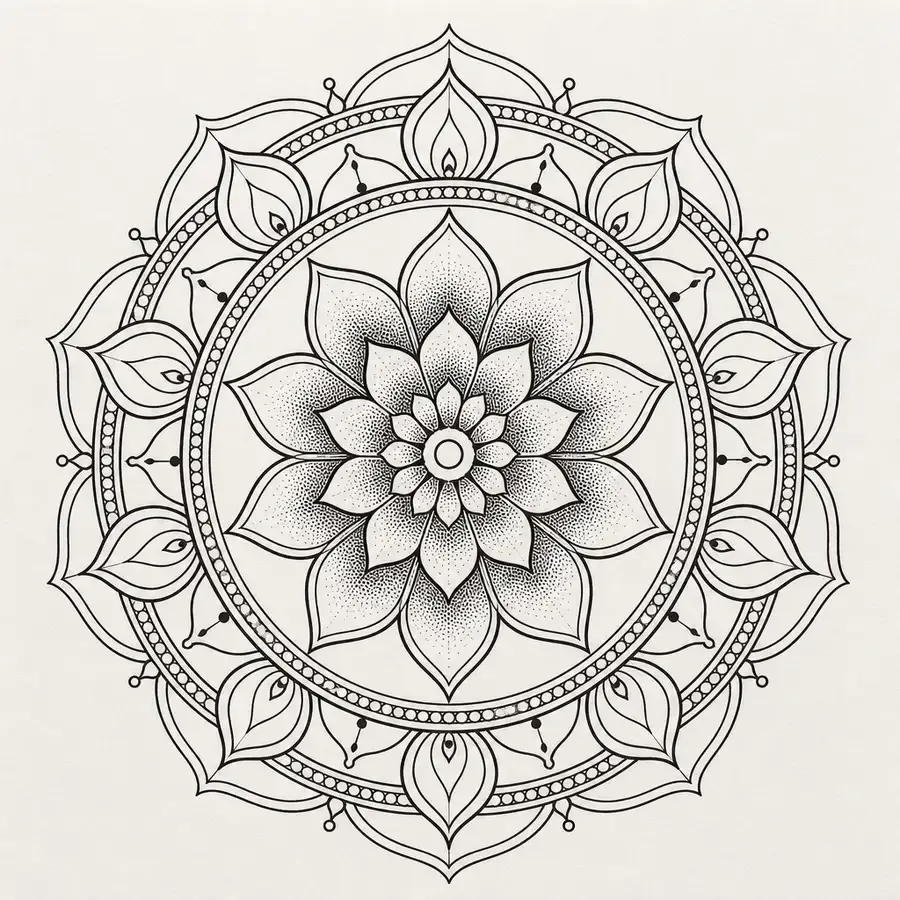 Lotus mandala Mandala
 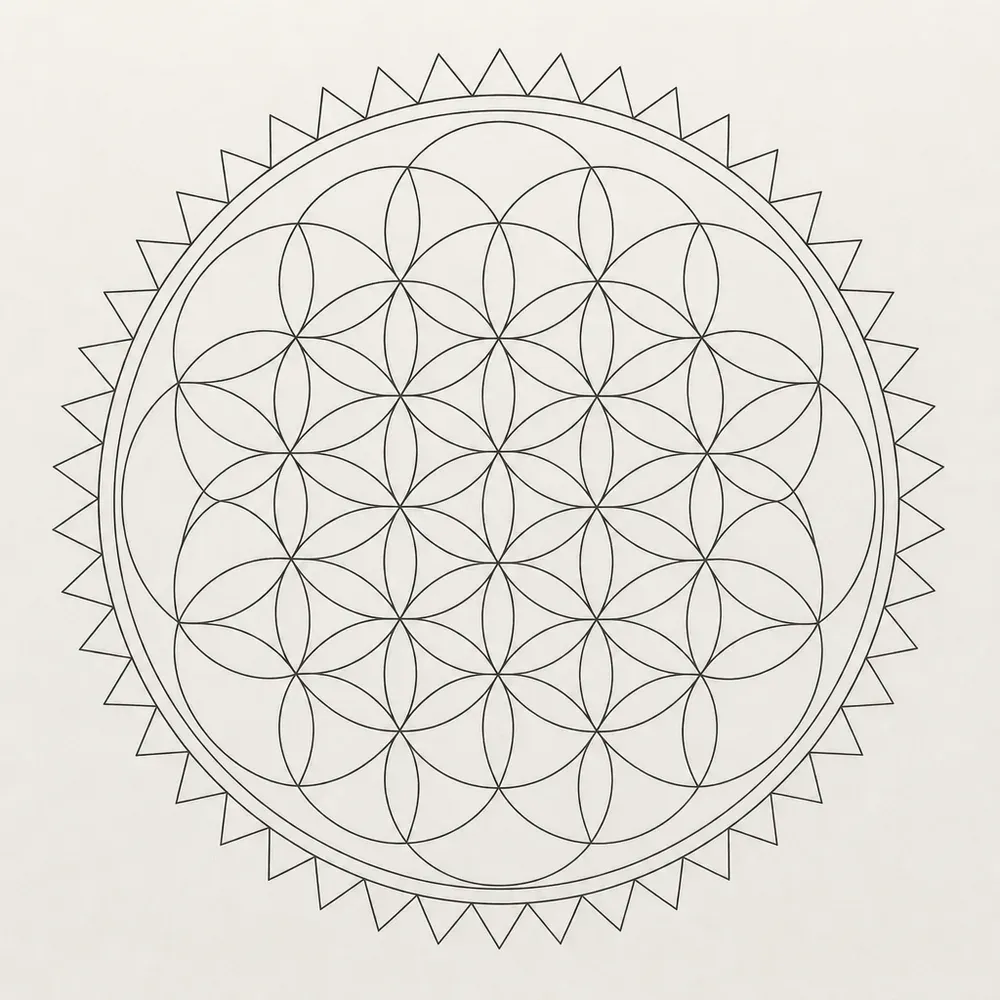 Flower of life Mandala
 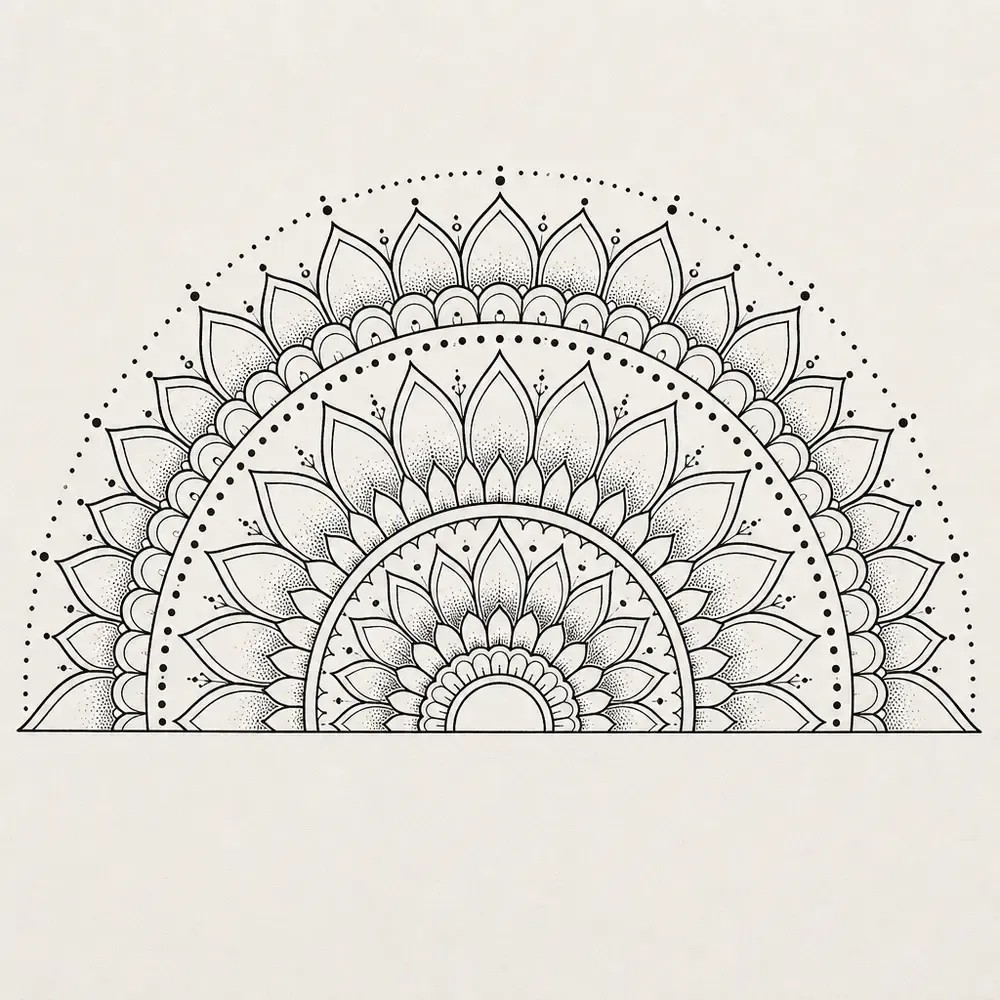 Half mandala Mandala
 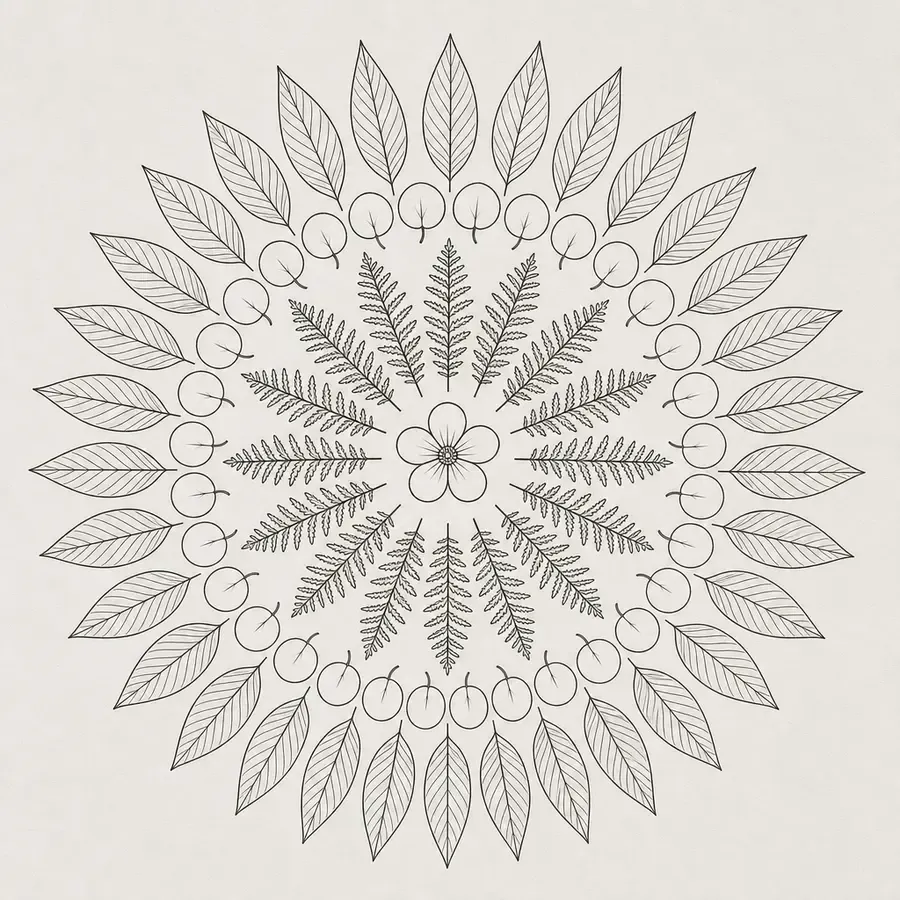 Botanical mandala Mandala
  Sternum drop, on a chest Mandala
 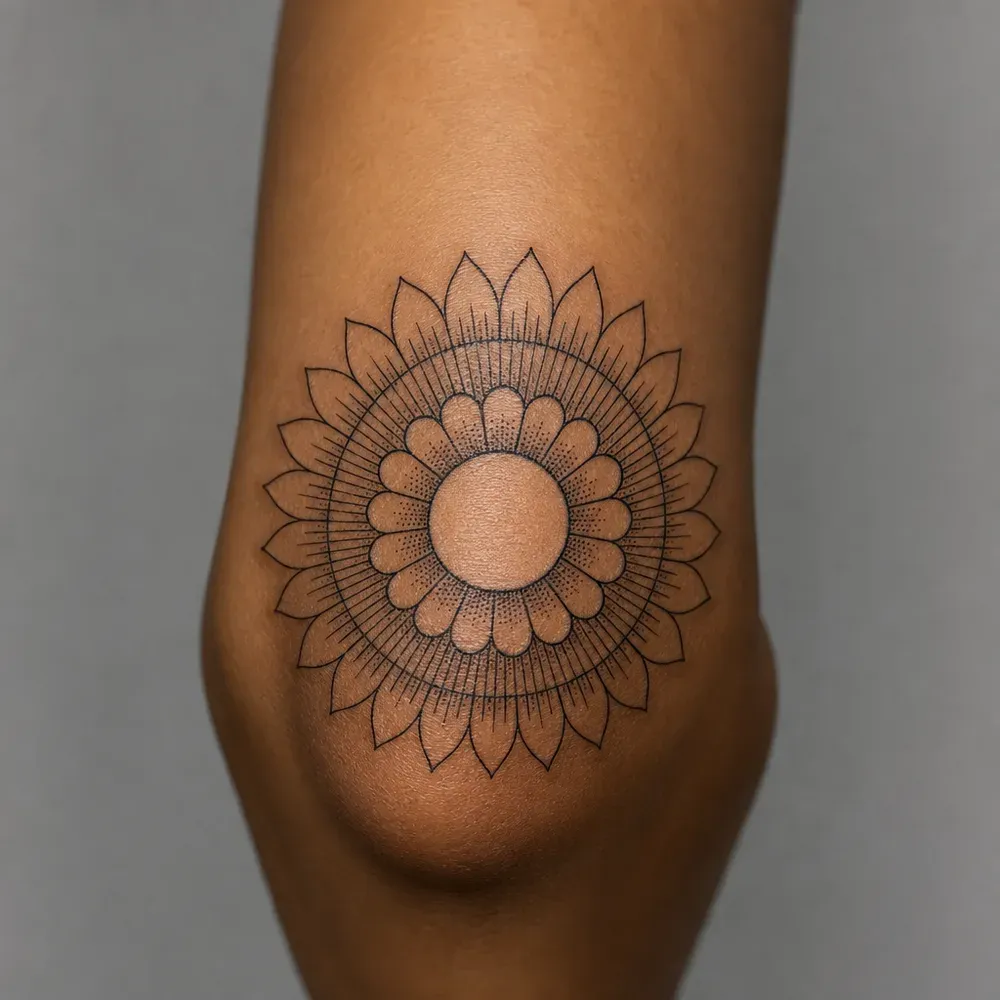 Mandala, above an elbow Mandala
 Common questions
- What does a mandala tattoo mean?
- Wholeness and balance, in the way most people use it. That reading comes mainly from the psychologist Carl Jung, who in the early twentieth century wrote that the circle drawn out from a centre stands for the whole self. The older meaning, from Hindu and Buddhist practice, is a map of a sacred space used in ritual and meditation.
- Is a mandala tattoo disrespectful?
- A decorative mandala, a rosette of petals and dots, is worn very widely and is rarely taken as disrespect. A copy of a specific ritual mandala, with its deities, its square palace and its four gates, is a different thing, and it is worth knowing what one is before wearing it.
- What does a lotus mandala mean?
- Two symbols at once: the circle for wholeness and the lotus for something that grew clean out of mud. The two belong together in Buddhist art, where the lotus often sits at the centre of the diagram, so the pairing is an old one.
- Do the number of petals in a mandala mean anything?
- In tantric and yogic drawings of the body's energy centres, each centre is a lotus with a set number of petals, four at the base of the spine and a thousand at the crown. Outside that system, the petal count of a decorative mandala is chosen for how it looks, and lists assigning a meaning to each number are recent.
- What does a half mandala mean?
- The same as a whole one. It is a layout choice that suits a forearm, a shoulder or the top of a foot, where a full circle would wrap out of sight. Nobody gave the half its own meaning, and you do not need one.
Related guides
If you are in Luzon
The same artist who wrote none of the above runs a home tattoo service across Luzon: he brings the whole setup to your house and the kit stays sealed until it is opened in front of you. He covers Olongapo, Subic, Castillejos, San Marcelino, Bataan and Pampanga.
An enquiry that names the design idea, the placement, a rough size in centimetres and your town gets a proper answer. Transport is yours to pay on top of the tattoo, worked out from the distance and quoted with it.