Hannya Mask Tattoo Meaning: a Woman, Not a Demon
LOT 20260923 · NO 16/43 · 873 WORDS · 4 MIN
A mask from Japanese Noh theatre showing a woman consumed by jealousy and grief until she has turned into something else. It is carved to be read at an angle: tilted down it clouds toward sorrow, tilted up it brightens, and holding both is the half most lists leave out. It has nothing to do with any Abrahamic devil.
She is a woman, and that is the part most pages leave out
The hannya is a mask from Noh, the Japanese theatre, carved for particular plays and worn by an actor playing a particular kind of character: a woman who has been eaten from the inside by jealousy and grief until she is no longer only a woman. The Victoria and Albert Museum, which holds one, describes it as a female serpent-demon filled with malicious jealousy and hatred, worn by the lead in the second acts of Aoi no Ue, Dojoji, Kurozaka and Momijigari.
Not a monster that was always a monster. A person something happened to. Almost every list you will find describes the hannya as a demon of rage, stops there, and loses the half that makes it worth putting on your body.
The thing the carvers built into it
This is the best fact about the mask and it is the one most often missed.
A Noh mask is carved so that it reads differently depending on the angle it is held at, and the theatre has names for the two moves. Turning the mask upwards is terasu, shining, and carries a happy state. Turning it downwards is kumorasu, clouding, and carries a sad one. The actor changes what the face is saying with the movement of his head rather than with his face, and the effect is strong enough that it has been measured experimentally.
That is not symbolism somebody attached afterwards. It is how the object was made, and it is what a hannya is built on: one carving has to hold a woman and the thing she has turned into, and it does that by being read at different angles rather than by being two masks. A hannya drawn flat and angry is a less interesting tattoo than one drawn at an angle that lets both readings sit in it.
What the tradition carries
Jealousy, and what it costs. The source reading, and the honest one. If your hannya is about having been consumed by something, it is doing the job the mask was carved for.
Transformation, and being past the worst of it. The mask is the end state of a change, not the beginning. That is where the protective reading comes from: the thing on your skin has already been through it.
The colours mean something. The Victoria and Albert Museum puts it plainly: the flesh tone of the face varies with the social rank of the woman portrayed, a lighter complexion indicating aristocratic status. That is a real convention from the theatre and not a tattoo invention, which makes the colour of yours a decision rather than a preference.
Where it sits in Japanese tattooing. The hannya is a core irezumi subject, usually drawn with maple leaves, snakes, peonies or wind bars, and those surroundings are grammar rather than decoration. Drawn in that style it is making a claim about the tradition it belongs to.
What was added later, or is simply wrong
“It is satanic.” It is not, and the question gets asked often enough to be worth answering plainly. The hannya comes from Japanese theatre and has nothing to do with any Abrahamic devil. The demon in it is a Japanese one and the story underneath it is a human one.
Horn length, tooth count, the exact shape of the eyes. You will find pages assigning meanings to each. They do not come from the theatre and they do not come from anywhere else either.
Calling any angry Japanese mask a hannya. An oni is a broad class of demon and ogre; the hannya is one specific character. A lot of tattoos called hannya are oni. Not a disaster, and worth knowing before you name yours.
The etymology. You will see it stated confidently that the name comes from the Buddhist word for wisdom, and stated just as confidently that it is named after the monk who carved the first one. Both accounts are in circulation and neither is settled, so anybody telling you firmly which it is has picked one.
If you are looking for the meaning in Tagalog
It comes up in the search box, so it is worth saying: there is no separate Filipino reading of the hannya. It is a Japanese mask with a Japanese story, and the meaning above is the meaning in any language. What the question is usually really asking is whether it is a bad thing to wear here, and the answer is that it is a story about grief, not a curse.
What it is like to sit for one
A hannya wants room. The face is carried by the expression, and an expression drawn small turns into a smudge inside a year. Most are done on an outer arm, a shoulder, a calf, a thigh or a chest panel, and those are middling on the pain chart rather than the sharp end.
A chest or rib piece is the exception and crosses into the worst of it. If the design pairs the mask with a snake or with leaves, the piece grows, and a growing piece means more than one session whatever it sits on.
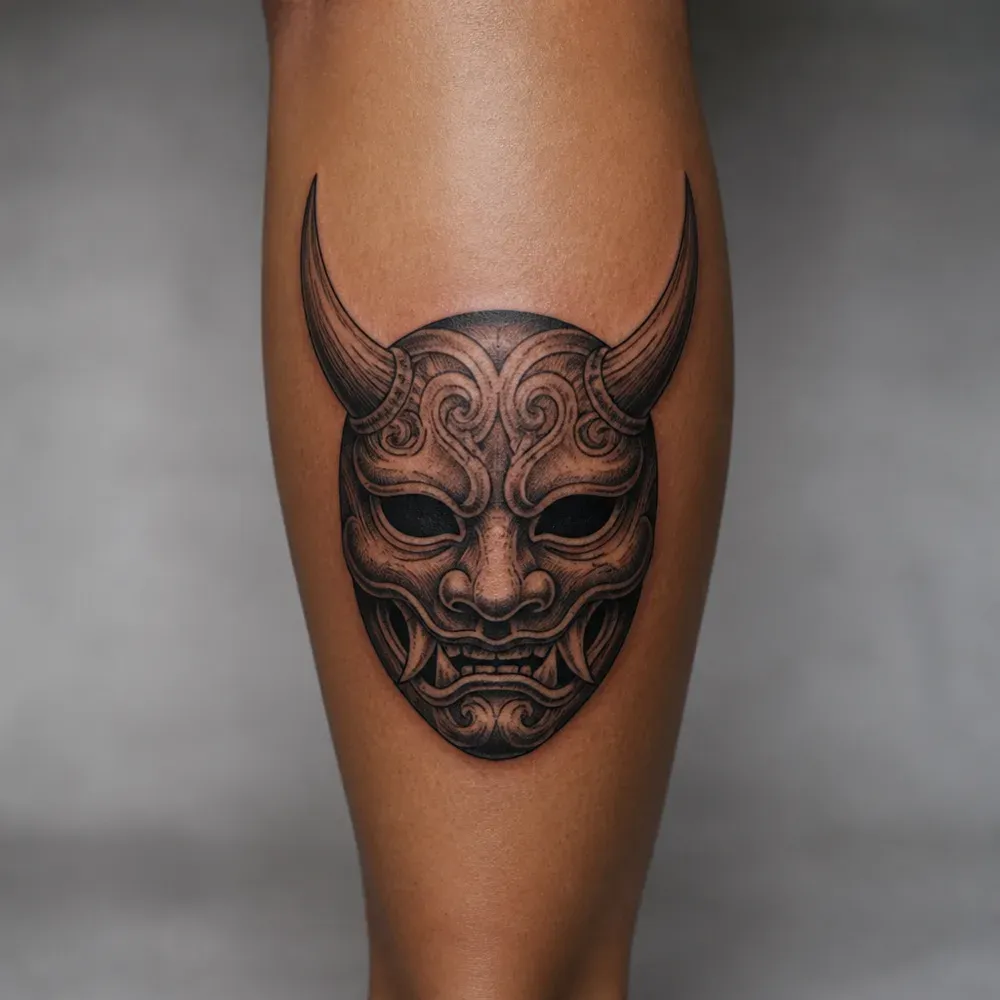
The mask this page is about, drawn and on skin.

Common questions
- Is the hannya mask a demon or a woman?
- Both, and that is the whole point of it. She is a woman who has been consumed by jealousy and grief until she has turned into something else. A hannya read as only a monster has lost the half that makes it worth wearing.
- Is a hannya mask satanic?
- No. It is a carved mask from Japanese Noh theatre, made for specific plays, and it has no connection to any Abrahamic idea of the devil. The demon in it is a Japanese one and the story is a human one.
- What is the difference between a hannya and an oni?
- An oni is a broad class of Japanese demon and ogre. A hannya is one specific thing: the mask of a woman transformed by jealousy, from Noh. A great many tattoos called hannya are actually oni, which is not a mistake worth losing sleep over but is worth knowing before you call yours by the wrong name.
- What do the colours of a hannya mask mean?
- The flesh tone varies with the social rank of the woman portrayed, a lighter complexion indicating aristocratic status, which is how the Victoria and Albert Museum describes the one it holds. That is a real convention from the theatre rather than something tattooing invented, and it gives you a way to choose a colour that says something.
- Is a hannya tattoo bad luck?
- Not in the tradition it comes from. It is often described as protective, because the thing on your skin has already been through the worst of it. Nothing about the design does anything, but the association is genuinely old rather than made up for a blog.
Related guides
If you are in Luzon
The same artist who wrote none of the above runs a home tattoo service across Luzon: he brings the whole setup to your house and the kit stays sealed until it is opened in front of you. He covers Olongapo, Subic, Castillejos, San Marcelino, Bataan and Pampanga.
An enquiry that names the design idea, the placement, a rough size in centimetres and your town gets a proper answer. Transport is yours to pay on top of the tattoo, worked out from the distance and quoted with it.