Koi Fish Tattoo Meaning, and the Rules People Argue About
LOT 20260923 · NO 19/43 · 1470 WORDS · 7 MIN
Perseverance, from one story: the carp that swims up the falls at the Dragon Gate and becomes a dragon. The upstream and downstream reading is a real convention among Japanese tattooers rather than an ancient rule, and the colour meanings come from Children’s Day carp streamers rather than from tattooing at all.
Almost all of it comes from one story
A carp swims up a river against the current and reaches a waterfall at a place called the Dragon Gate. Most turn back. One keeps going, clears the falls, and is turned into a dragon.
That is the source. The Chinese legend is old, it travelled to Japan, and it is where every serious koi meaning comes from: perseverance, going against the current, becoming something else by refusing to stop. If somebody asks what your koi means and you tell them that story, you are on solid ground.
What follows is the rest of it, sorted into what the tradition actually carries and what was added later. The second list is not worthless. It is just younger than it is usually presented as being.
What the tradition carries
Perseverance, and transformation through it. The Dragon Gate reading. This is the one that is genuinely old and genuinely Japanese and Chinese, and it is why a koi and a dragon are so often drawn in the same piece, sometimes as one fish mid-change.
Good fortune. Koi are a fortune symbol in both traditions, independent of the falls story, and have been for a long time.
The place koi hold in Japanese tattooing. Koi are one of the core subjects of irezumi, drawn with water, wind bars, maple leaves or lotus, and those surroundings are part of the grammar rather than decoration. A koi drawn in that style is making a statement about the tradition it belongs to, which is worth knowing whether or not you want to make it.
The rules people argue about
Which way it swims. Upstream for a struggle you are still in, downstream for one you have come through. This is the single most argued point about koi tattoos, and the honest position is that it is a real convention among Japanese tattooers and not an ancient rule. Ask five artists and you will get the reading back, and you will also get at least one who says it is read the other way round, and one who says the fish should simply suit the body it is on. Agree what yours says with your artist before the drawing is finished, because it is easier to settle on paper.
The colours. You will find a list: black for the father, red for the mother, blue for a son. That list is real, and it is not from tattooing. It is from koinobori, the carp streamers flown for Children’s Day, where the colours do stand for members of a family. Transplanting those meanings onto a tattoo is a modern move. It is a lovely idea for a family piece and it is worth knowing it came from a flag rather than from a tattoo tradition.
Two koi together. Read as balance, and usually by way of yin and yang. The yin and yang symbol is Chinese and is not two fish; the fish reading is a later overlay. It is now so common that it means balance in practice, which is a fair description of how most symbols end up meaning anything.
Scale counts, fin positions, the number of bubbles. Assigned meanings exist for all of these in published lists. They do not come from anywhere.
Two koi fish, and what the pair means
Two koi drawn head to tail in a circle are the most requested koi layout after the single fish, and they get their own section because the meaning people attach to them has three separate sources.
Balance, by way of yin and yang. The circling pair is read as two opposites held together. The yin and yang symbol is Chinese and older than any koi tattoo, and it is not two fish; the two teardrop halves were redrawn as koi much later. The reading is real in practice, because it is how almost everyone now reads the design, and recent in origin.
A couple. Two koi as two people, often one dark and one light, is the most common reason the pair is chosen. That is a modern reading too, and a good one, and it does not need the yin and yang to carry it. Matching koi on two people, one each, is a variation of the same idea.
One up, one down. Some pairs swim in opposite directions on purpose, one fish still in the struggle and one through it. That borrows the upstream and downstream convention above and applies it to two people or two halves of one life, and it is worth agreeing with your artist which fish is which before the drawing is finished.
What the pair does not mean is anything about the number two in the Dragon Gate story. That story is about one fish that kept going. If you want the perseverance reading and the balance reading, they can both be there, as long as you know they came from different places.
Koi fish tattoo designs, and which layout says what
What is drawn around the fish matters as much as the fish, and in Japanese work it always has. The koi designs on this site show each of these.
Climbing a waterfall or rough water. The Dragon Gate itself, the struggle still going on. This is the koi at its most traditional.
Halfway to a dragon. A carp body with a dragon’s head and claws, rising out of the water. It is the moment the story is about, and it says the struggle paid off.
With a lotus. The lotus grows out of mud and opens clean above the water, which is the old Buddhist and Hindu reading of rising out of a hard start. Next to a koi it doubles the idea of coming through something. The lotus guide has the flower’s own history.
With cherry blossom, peony or maple leaves. These are the seasonal elements of Japanese tattooing. The cherry blossom carries the Japanese sense of how briefly things last, and the peony is a flower of wealth and good fortune in Chinese and Japanese art. In a koi piece they also set the season and fill the space around the fish, which is part of how irezumi is composed.
With the moon. A koi leaping past a crescent moon is a modern design. Lovely to look at, with no tradition behind the pairing.
A single fish in fine line. One small koi in a few thin lines drops the water and the setting, and with them most of the traditional grammar. It still carries the perseverance reading, and at a small size it holds up far better than a detailed fish shrunk down.
The colour of the fish itself
Separate from the koinobori colour list above, koi breeders name their fish by pattern, and people sometimes ask for a tattoo of a particular kind. A kohaku is white with red markings, the classic koi. A showa is black with red and white. A tancho is white with a single round red patch on its head, and because that patch echoes the red sun of the Japanese flag it is a favourite in Japan. These are names for real fish rather than tattoo meanings. They are a good way to tell your artist exactly what you are picturing.
How to choose which reading is yours
The test is the same as for any symbol. Say it out loud. If what comes out is the Dragon Gate story and why it is yours, the tattoo is doing its job. If what comes out is a sentence about a colour chart you half remember, that is a reason to think for another week rather than a reason not to get it.
Worth adding that a koi is one of the few designs where telling people it is “just because I like it” is a completely reasonable answer. It is a beautiful fish and it has been drawn for centuries because it is a beautiful fish.
What it is like to sit for one
Koi are drawn large more often than small, because the scales, the fins and the water around them need room, and a koi shrunk too far loses the detail that made it a koi. A realistic one at palm size is usually a better tattoo than the same design at thumb size.
They suit the shapes that flow: a forearm, an outer thigh, a calf, a shoulder running onto the upper arm, or the classic back and side piece where the water can be drawn around it. Those are mostly comfortable placements, though a piece that wraps onto the ribs or the inner arm crosses into the sharper end of the chart, and a large koi is usually more than one session whatever it sits on.
Koi from the gallery: upstream, downstream, the Dragon Gate, and the circling pair this page says is younger than it looks.
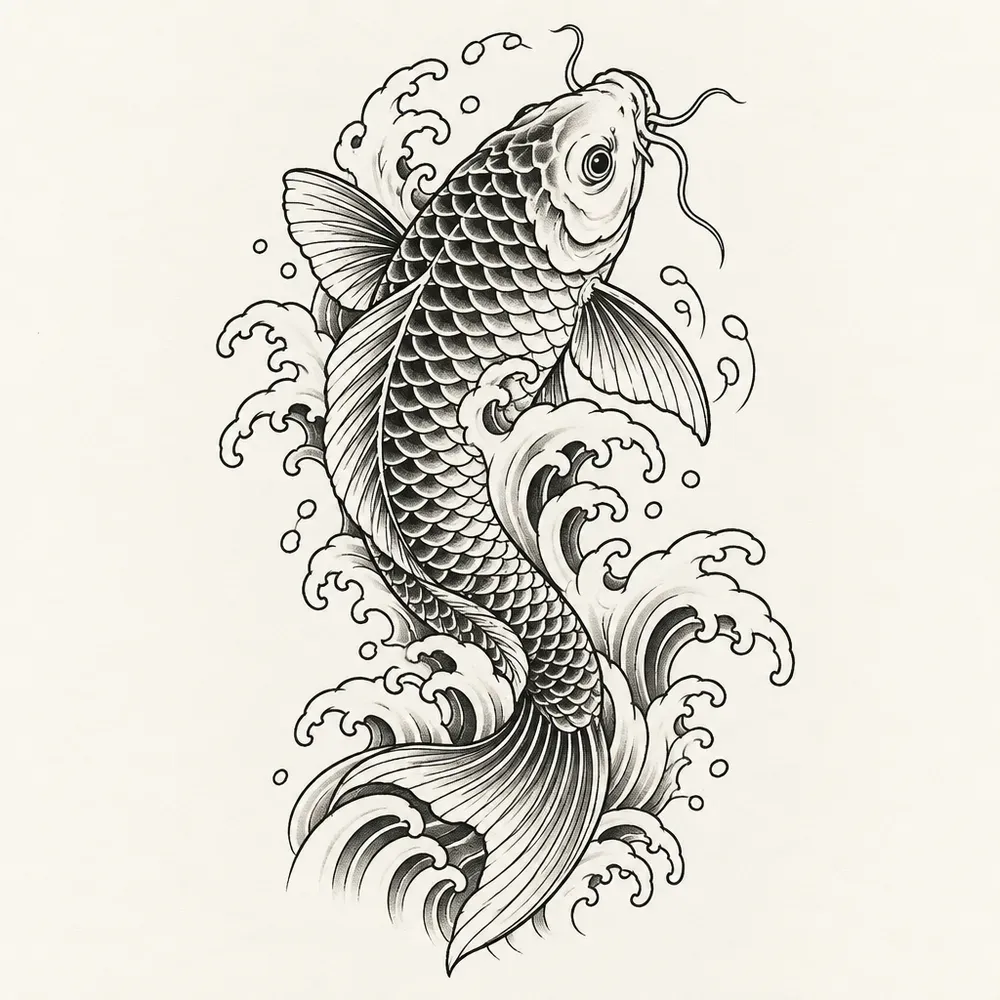 Koi, upstream Japanese
 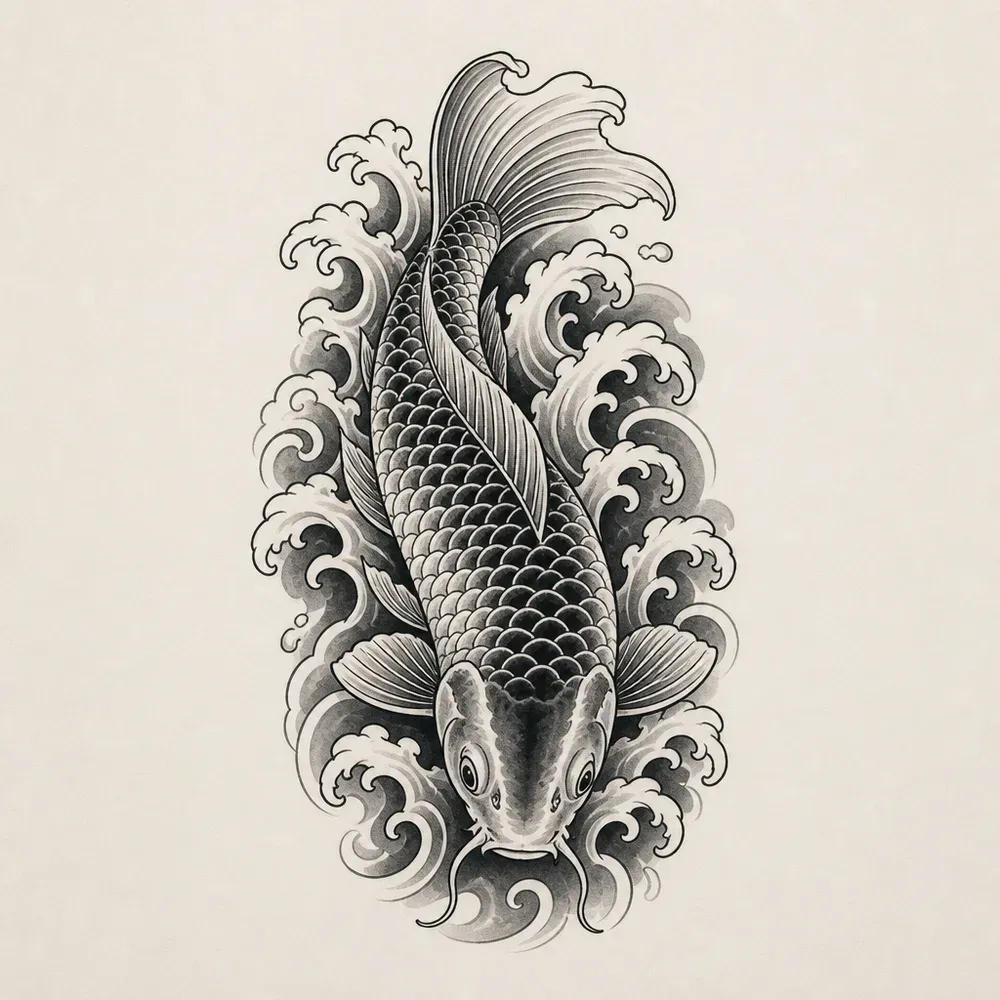 Koi, downstream Koi
 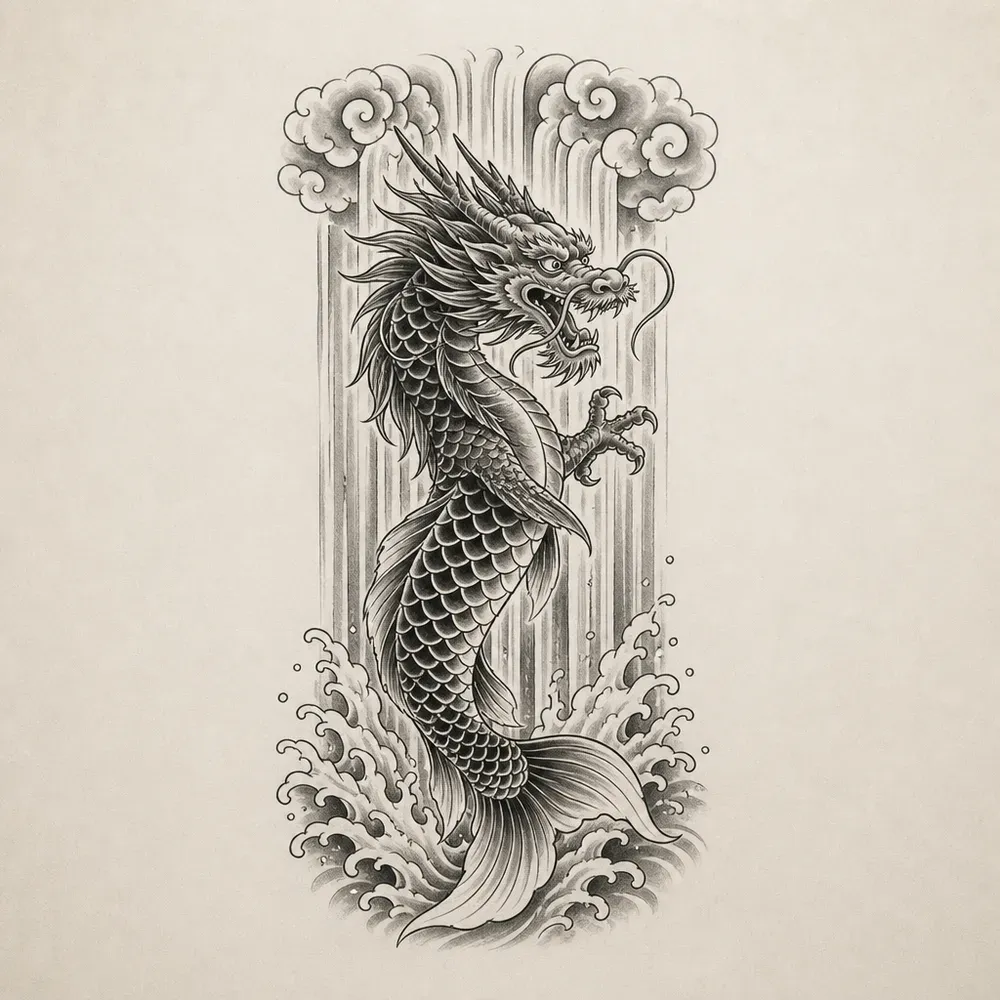 Koi at the Dragon Gate Koi
  Koi pair Japanese
 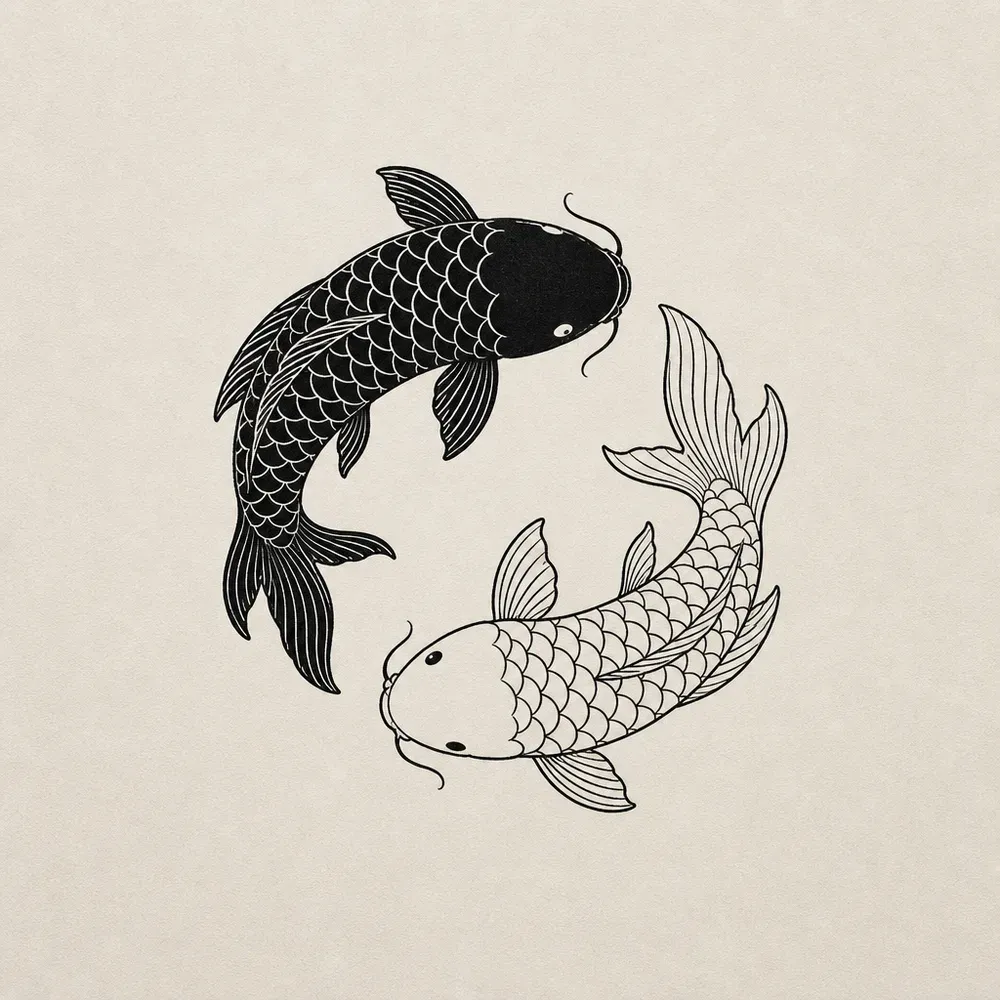 Koi yin and yang Koi
 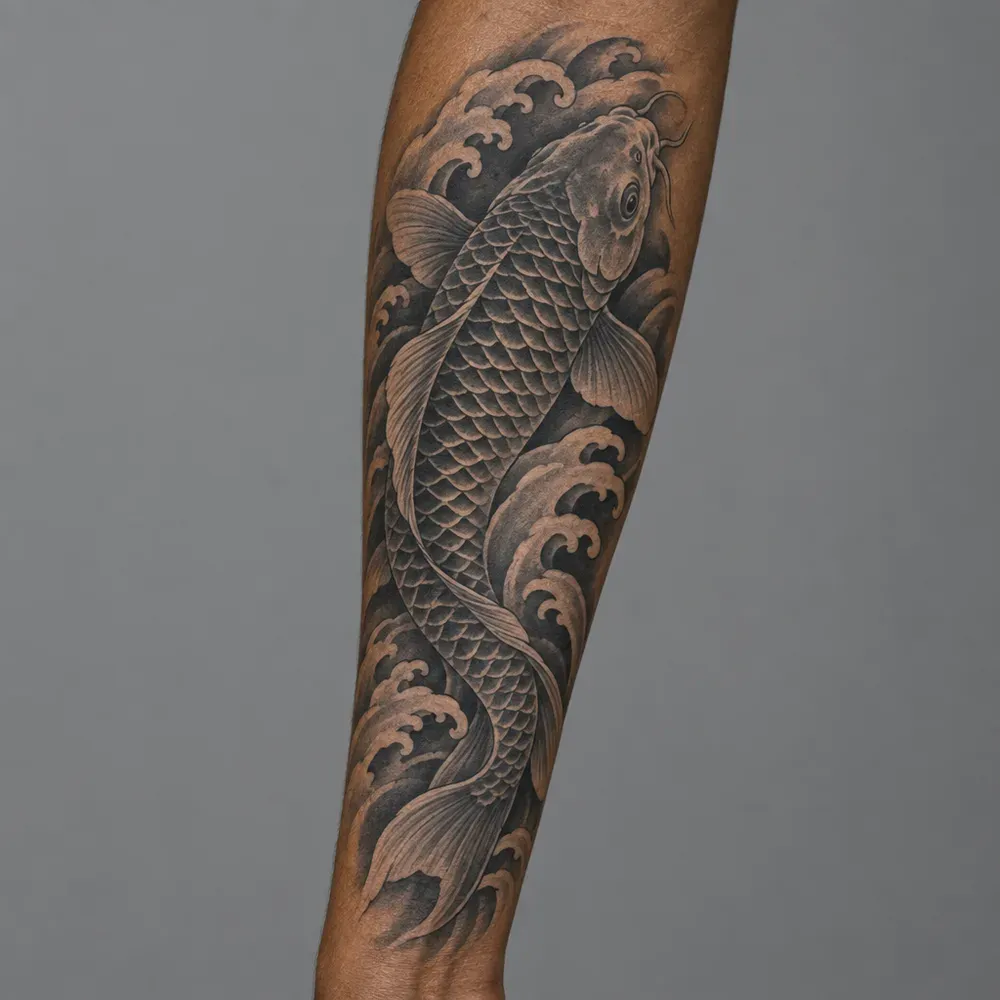 Koi, on a forearm Japanese
 Common questions
- What does a koi fish tattoo mean?
- Perseverance, and it comes from one specific story: the carp that swims up the falls at the Dragon Gate and becomes a dragon. Everything else attached to koi is either built on that or was added much later.
- Should a koi fish tattoo face up or down?
- Upstream is the common reading for a struggle you are still in, downstream for one you have come through. It is a real convention among Japanese tattooers rather than an ancient rule, and plenty of artists will tell you it is read both ways, so it is worth agreeing what yours says before the drawing is finished.
- What do the colours of a koi tattoo mean?
- The colour meanings you will find listed, black for the father, red for the mother, blue for a child, come from koinobori, the carp streamers flown for Children's Day in Japan. That is a real tradition. Attaching those family meanings to a tattoo is a modern transplant rather than something Japanese tattooing carried.
- What does two koi fish mean?
- Usually balance, and usually by way of the yin and yang symbol, which is Chinese and is not a pair of koi. The two are commonly drawn as koi and read as koi, which makes the meaning real in practice and recent in origin.
- What does a koi turning into a dragon mean?
- The end of the Dragon Gate story: the carp that cleared the falls and was changed for it. A koi drawn halfway to a dragon is the reward for perseverance shown in the middle of happening, and it is one of the oldest and clearest koi meanings there is.
- What does a koi and lotus tattoo mean?
- Two readings put together. The koi brings perseverance from the Dragon Gate story, and the lotus, which grows out of mud and flowers clean above the water, brings rising out of a hard start. Both readings are old. Putting them in one piece is a common modern choice and they suit each other.
- Is a koi tattoo lucky?
- Koi are associated with good fortune and with perseverance in both Chinese and Japanese tradition, so yes in the sense that the association is genuinely old. No in the sense that nothing about the design does anything.
Related guides
If you are in Luzon
The same artist who wrote none of the above runs a home tattoo service across Luzon: he brings the whole setup to your house and the kit stays sealed until it is opened in front of you. He covers Olongapo, Subic, Castillejos, San Marcelino, Bataan and Pampanga.
An enquiry that names the design idea, the placement, a rough size in centimetres and your town gets a proper answer. Transport is yours to pay on top of the tattoo, worked out from the distance and quoted with it.