Snake Tattoo Meaning: Which Readings Are Old and Which Were Invented
LOT 20260923 · NO 26/43 · 1565 WORDS · 7 MIN
Shedding and starting again is the oldest reading and the one that needs no defending. The ouroboros, the rod of Asclepius and the Japanese guardian snake are genuinely old too. The snake and dagger, the coil counts and the betrayal reading are recent inventions, which does not make them worse, only younger.
The snake is the test case for how tattoo meanings work
Most published symbol meanings are younger than they look. The snake is the best place to see that, because it is one of the few designs where some of the readings really are ancient and the rest were made up recently, and the two sit side by side on the same list without anyone marking which is which.
So this splits them. What follows is not a ranking of which meaning is better. It is a note of where each one came from, so that when someone asks you what your tattoo means you can answer with something you can stand behind.
The readings that are genuinely old
Shedding, and starting again. The snake sheds its entire skin and leaves it behind, intact and snake-shaped. Almost every culture that has snakes has noticed this and built something on it, which is why it is the one reading you will find everywhere and the one that needs no defending. If you want a tattoo about coming out the other side of something, this is the design with the longest claim to it.
The ouroboros, the snake eating its own tail. Egyptian funerary texts first, then Greek alchemy, and it has meant roughly the same thing for three thousand years: a cycle with no beginning and no end. It is one of very few tattoo symbols where the modern meaning and the original one still match.
Medicine. The rod of Asclepius is a single snake wound around a staff, and it is the reason snakes appear on ambulances and pharmacies. Worth knowing that the two-snake winged version, the caduceus, is a different object that got mixed up with it and belongs to Hermes, the messenger god and a patron of negotiation, trade and commerce. If the tattoo is about medicine, one snake is the correct one, and the US National Library of Medicine has written up how thoroughly the two get confused.
The guardian. In Japanese work the snake protects, wards off illness and bad luck, and is associated with good fortune rather than with menace. A Japanese-style snake is not a warning.
The tempter. The Genesis reading is real and old and it is where the western instinct that a snake means evil comes from. What is worth saying is that it is ONE tradition among several, not the meaning of snakes in general, and it points the opposite way from the Japanese one.
The cobra on the crown. In ancient Egypt a rearing cobra, the uraeus, sat on the front of the pharaoh’s crown as a protector of the king. A cobra with its hood spread is old as a sign of guarding and power, and the hooded cobra in Western traditional flash borrows the look if not the history.
The naga. In Hindu and Buddhist art the naga is a serpent being, and one of the best known images shows the serpent king Mucalinda coiling under the meditating Buddha and spreading his hoods over him to keep off a storm. A many-headed cobra rising behind a figure is that story, and it is a religious image before it is a decoration.
The snake in the Philippines
The Bakunawa. The serpent in Philippine stories is the Bakunawa, a huge sea serpent from the Visayas and Bicol that rises from the water and swallows the moon, which is how an eclipse was explained. People banged pots and made as much noise as they could until it let the moon go. The Aswang Project has collected the versions, and notes that the best-known retellings differ from each other. A Bakunawa tattoo is a snake that a Filipino reader will recognise and a foreign list will never mention: an appetite large enough to eat the moon, and a world that refused to let it.
The year of the snake. For Chinese-Filipino families the snake is one of the twelve animals of the Chinese zodiac, and a snake tattoo can simply mark someone born in a snake year. The most recent was 2025, and before it 2013, 2001, 1989 and every twelve years back. The year turns at Lunar New Year rather than on 1 January, so anyone born in January or early February should check which animal their birthday actually falls under before it is drawn.
The snake in the house. You will also hear warnings about snakes as bad omens, and the opposite, that a snake in the house brings luck. These vary from family to family and from province to province, and there is no single Filipino reading to set against the others. Ask the people who will see the tattoo most what they grew up hearing.
The readings that were invented recently
The snake and dagger. Danger held under control, or power kept in check. It reads clearly and it is a good tattoo. It is also a convention of Western traditional flash from the last century, not an inherited symbol, and there is no ancient source for it whatever any list tells you.
Numbers of coils, direction of the head, whether the tongue is out. You will find pages assigning specific meanings to each of these. They do not come from anywhere. They are the sort of detail that gets written once to fill out an article and then repeated until it sounds established.
The two headed snake. Being pulled two ways, usually. A modern design idea with no tradition behind it, which means the meaning is genuinely yours to set.
“Snake means betrayal.” This one is recent and mostly comes from the word being used about people. It is a real association in English and it is not a symbolic tradition.
Snake tattoo designs, and what each shape says
The shape of the snake changes which reading people see first, so it is worth choosing the drawing with the meaning in mind. The snake designs on this site cover each of these.
Coiled or spiral. A snake resting in a coil reads as calm, contained power. It is the most neutral shape and the one that suits a round placement like a shoulder blade.
The ouroboros. The closed circle of a snake eating its tail carries its own ancient meaning, the cycle with no end, and nothing else needs adding to it.
Wrapped round a limb. A snake winding once around an ankle, a wrist or an arm is mostly a design choice rather than a symbol. It moves with the body and it is one of the best reasons to choose a snake at all.
With flowers. A snake with a rose, a peony, lilies or a chrysanthemum is the most requested combination. In Japanese work the snake and peony is a classic pairing. The usual modern reading is two sides of one thing: danger and beauty, or change and what grew after it.
With an apple. This is the Genesis snake, and it brings the temptation reading with it. If that is not what you mean, leave the apple out.
The cobra. A rearing cobra with its hood spread reads as a guard or a threat, depending on who is looking. The traditional flash cobra and the Egyptian uraeus look alike and come from different places.
With the moon. A snake around a crescent moon is popular and has no old tradition behind it. The Bakunawa is the nearest thing, and it is a snake swallowing the moon rather than guarding it.
Tiny and fine line. A small snake in one thin line keeps the shape and drops every detail, which makes it one of the few animals that still reads clearly at a few centimetres.
Which of these is the right one
Whichever one you can say out loud without repeating a sentence you read.
That is the whole test, and it is the same test as for every other symbol. A snake that means you came through a bad year is a good tattoo because you know why it is there. A snake that means what the fourth result told you it means is a picture of a snake, which is also fine, but do not be surprised when you cannot answer the question.
The one thing worth checking before you commit is that the reading you want does not collide with one you did not know about. A Japanese-style snake and a Genesis snake mean close to opposite things, and they can be drawn similarly enough that people read yours the other way. That is an argument about the style it is drawn in, not about whether to get it.
What it is like to sit for one
Snakes suit long shapes: a forearm, a calf, up the outside of a thigh, around an upper arm. That is one of the reasons they are so common. It is also why they often cross more than one pain band, so a snake that runs from an outer forearm onto the wrist is comfortable for most of its length and sharp at the end.
If the design wraps, it will cross the inside of the limb, which is thinner skin than the outside and usually a point or two higher. The pain chart has the ordering, and where a snake goes is worth settling before the drawing is finished rather than after.
Snakes from the gallery in the forms this page discusses: the ouroboros, the cobra, the snake and apple, a Japanese snake over a peony, a snake around the moon, and one wrapped round an ankle.
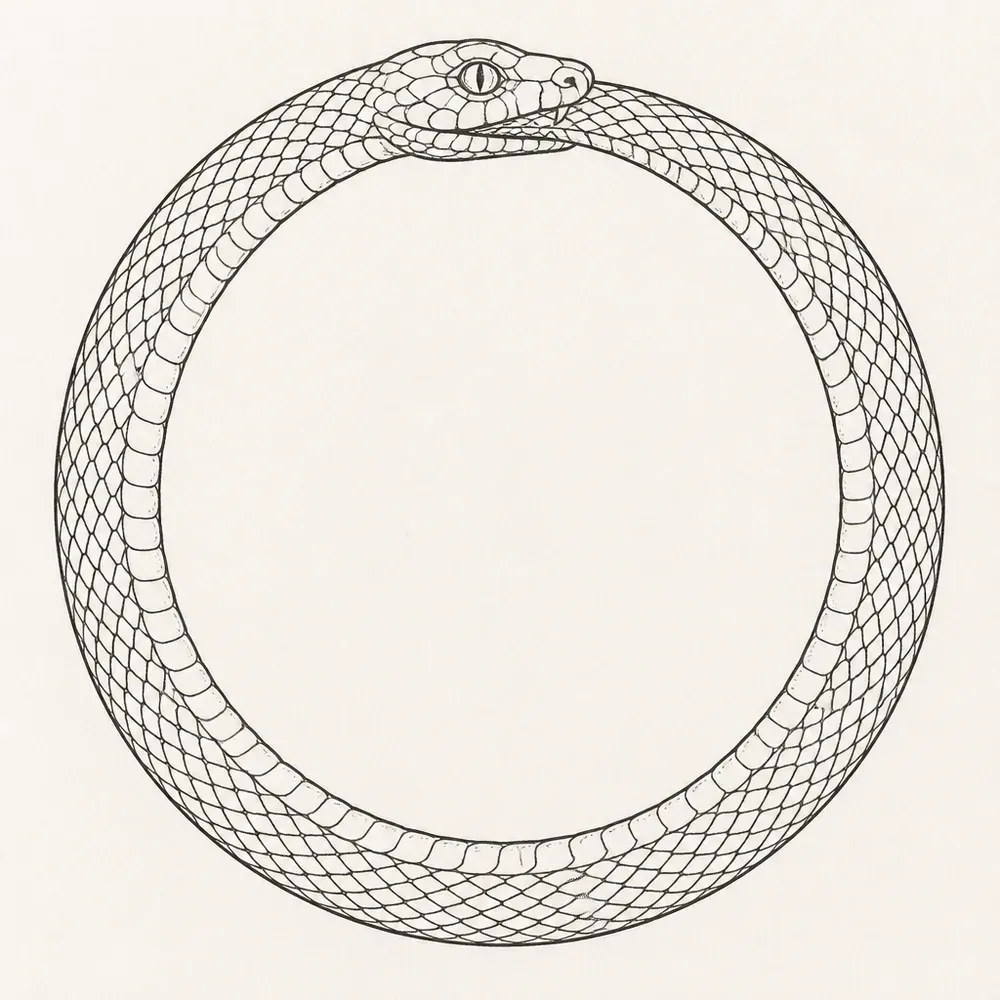 Ouroboros Snake
 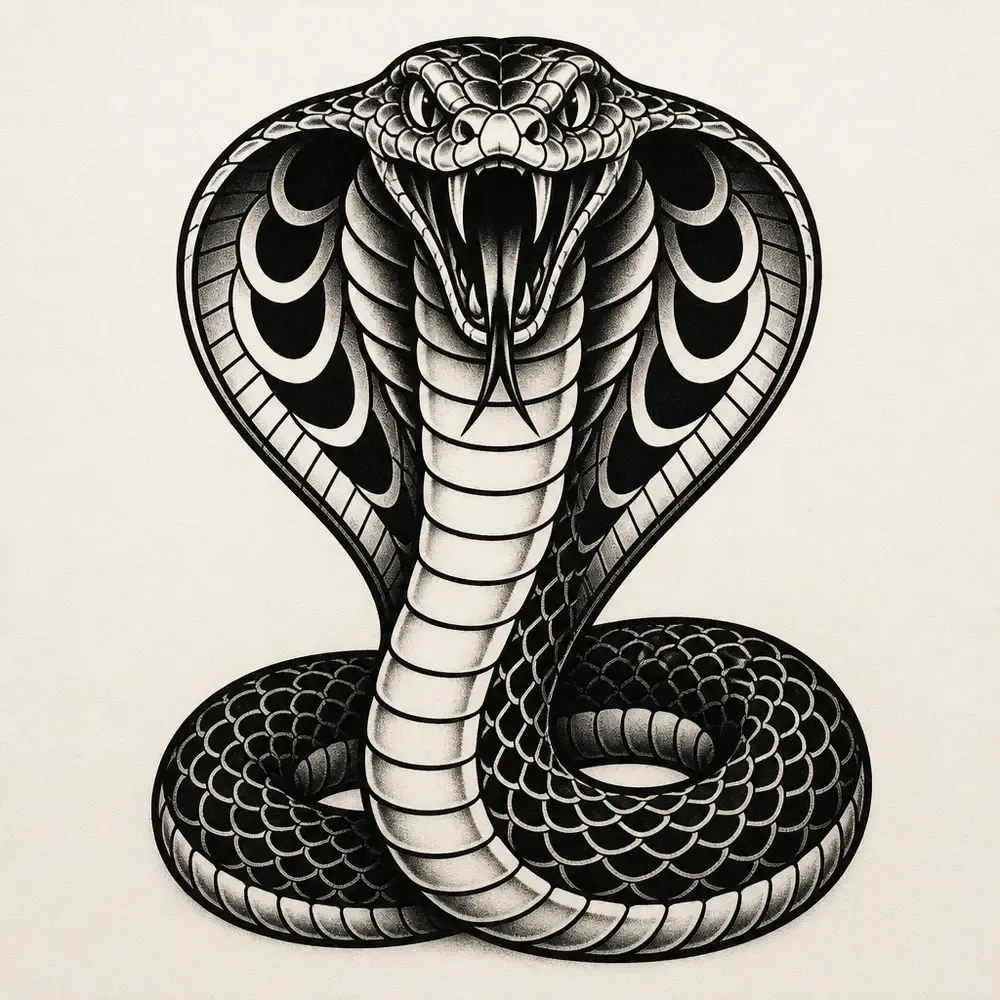 Cobra Snake
  Snake and apple Snake
 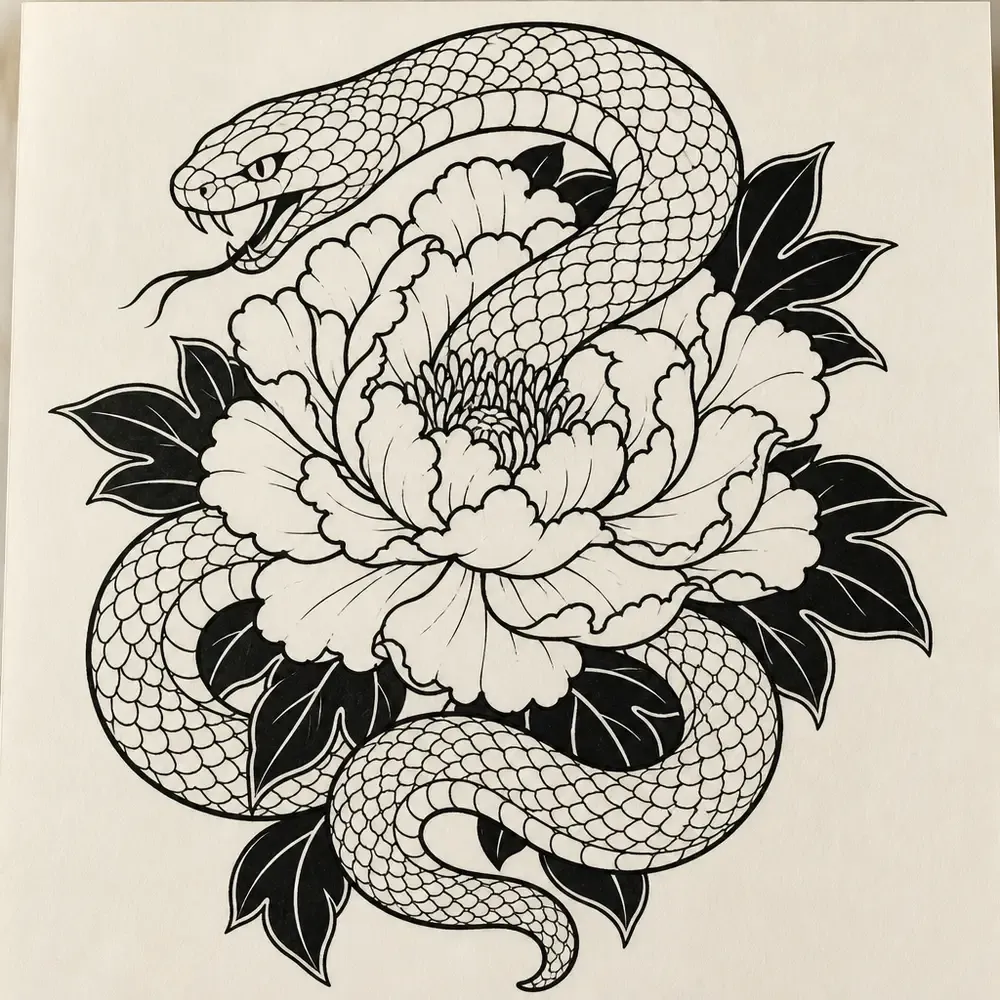 Snake and peony Snake
 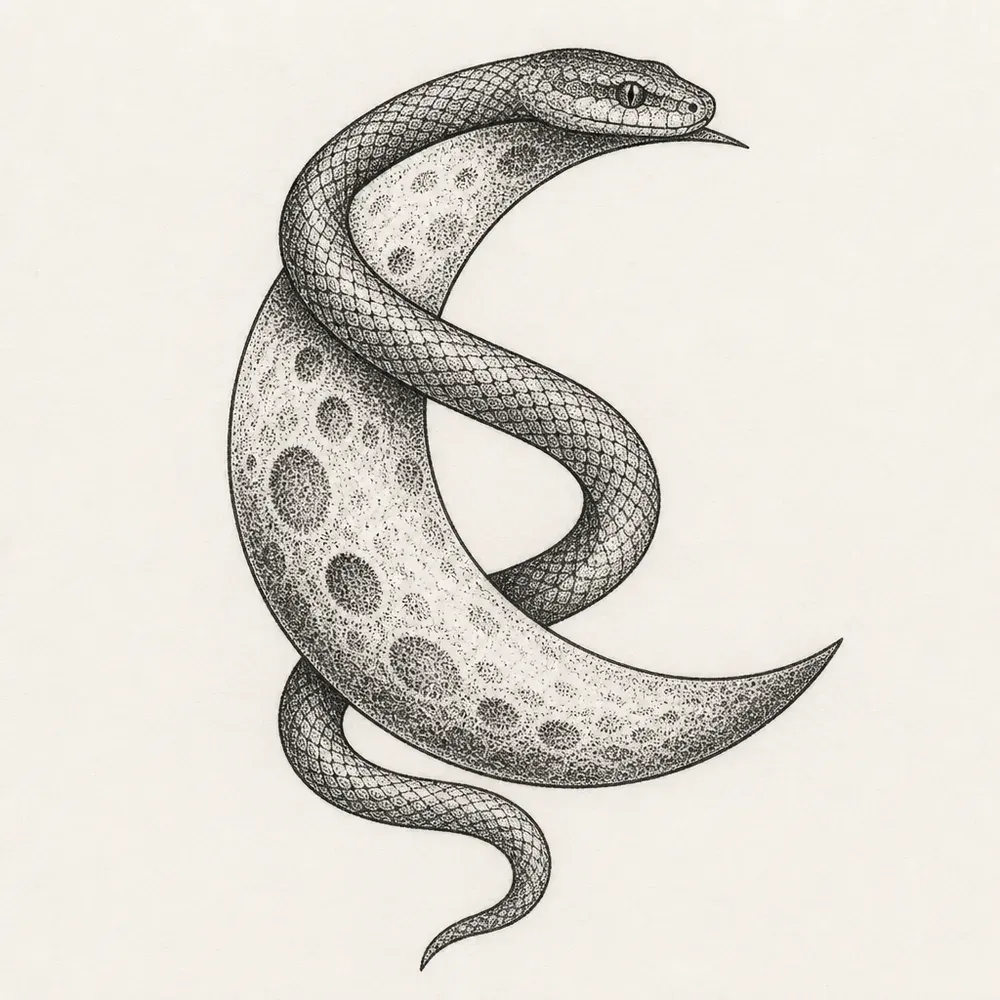 Snake and crescent moon Snake
 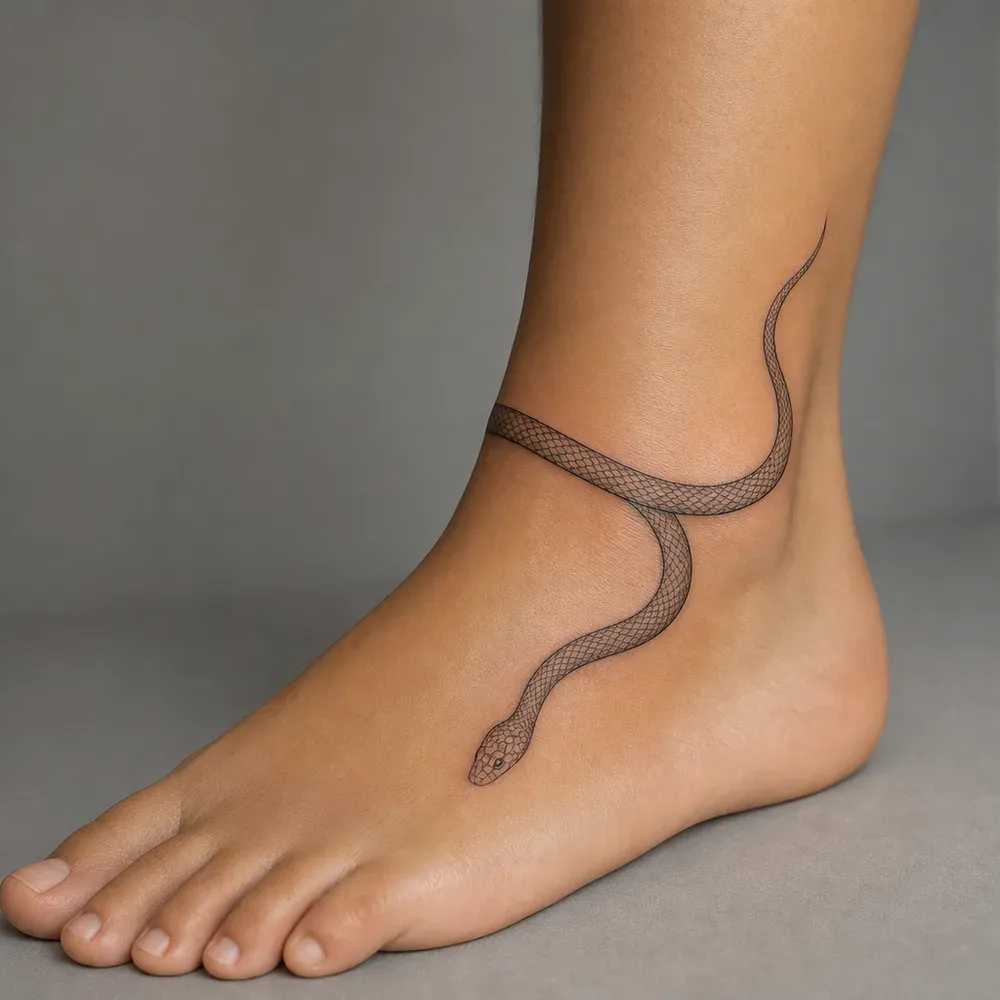 Snake, around an ankle Snake
 Common questions
- What does a snake tattoo mean?
- Shedding and starting again is the reading almost everyone arrives at, and it is the oldest one: a snake sheds its whole skin and walks away from it. Everything else depends on which tradition you are standing in, and several of them contradict each other.
- Is a snake tattoo bad luck?
- Not in most of the traditions the design comes from. The snake is a guardian in Japanese work and a healer in Greek medicine. The reading where it means evil is specifically the Abrahamic one, and it is one reading among several rather than the meaning.
- What does a snake wrapped around a dagger mean?
- It is a tattoo convention rather than an old symbol. It reads as danger held under control, and it comes from traditional Western flash of the last century, not from antiquity. That does not make it a worse tattoo; it makes it a younger one.
- What does a snake eating its own tail mean?
- That is the ouroboros, and it is genuinely ancient. It first appears in Egyptian funerary texts and later in Greek alchemy, and it reads as a cycle with no beginning or end. It is one of the few snake designs whose meaning has stayed roughly the same for three thousand years.
- What does a two headed snake tattoo mean?
- There is no old tradition behind it. It reads as being pulled two ways, and it is a modern design idea rather than an inherited symbol, so what it means is mostly what you say it means.
- What does a snake tattoo mean in the Philippines?
- The serpent with the deepest roots here is the Bakunawa, the sea serpent of Visayan and Bicolano stories that swallows the moon during an eclipse until people make enough noise to make it let go. For Chinese-Filipino families the snake is also one of the twelve animals of the zodiac, and a snake can simply mark someone born in a snake year.
- What does a snake and flower tattoo mean?
- Usually the two halves of one person or one story: the snake for danger, change or strength and the flower for something softer beside it. The pairing is a strong convention in Japanese work, where a snake with a peony or chrysanthemum is a classic subject, but the specific meaning of the pair is modern and is yours to set.
- What does a snake tattoo mean on a woman?
- The same readings as on anyone, and most often shedding a skin and coming out new. The Medusa reading, worn by survivors, is one that is specific to women, and it has its own page on this site. A snake does not carry a different symbolic meaning because of who wears it.
Related guides
If you are in Luzon
The same artist who wrote none of the above runs a home tattoo service across Luzon: he brings the whole setup to your house and the kit stays sealed until it is opened in front of you. He covers Olongapo, Subic, Castillejos, San Marcelino, Bataan and Pampanga.
An enquiry that names the design idea, the placement, a rough size in centimetres and your town gets a proper answer. Transport is yours to pay on top of the tattoo, worked out from the distance and quoted with it.