Compass Tattoo Meaning, and What to Decide Before It Is Drawn
LOT 20261012 · NO 07/43 · 1207 WORDS · 5 MIN
Finding your way, and usually your way back. The compass rose comes from sea charts, and sailors wore it for a safe return home. The rest is newer.
Where the meaning comes from
A compass tattoo is almost always a compass rose: the star of points printed on sea charts to show the directions. It is older than the magnetic needle it is now drawn with. Sailors in the Mediterranean named the winds by the direction they blew from, and the rose began as a diagram of those winds, eight main ones, then halves and quarters until there were thirty-two. The roses on fourteenth-century Catalan sea charts are among the earliest surviving, and the IET archives have a short history of how the wind rose and the needle came together.
So the original meaning is practical. A compass rose told you which way you were facing on a sea with nothing else to go by. Every reading a tattoo carries now is built on that.
The readings that are genuinely old
The way home. Sailors were tattooing long before tattoo shops existed on land, and much of the Western flash people still choose today came off ships: the swallow, the anchor, the nautical star and the compass. Collectors Weekly has a good account of how much of modern tattooing started at sea. A compass on a sailor was a wish to get back safely. That is the oldest reading and the one with the most weight behind it.
The nautical star. A five-pointed star shaded in alternating dark and light, usually read as the North Star a navigator steered by. It is related to the compass rose and is often mistaken for it. The sources for exactly what sailors meant by it are thin, so read the “guiding star” meaning as a long tradition among tattooers rather than a documented rule. It is still the same idea: something fixed to steer by.
North marked with a flower. Older compass roses mark north with a fleur-de-lis, the stylised lily, and many tattoo compasses keep it. It is a mapmaker’s convention rather than a symbol with its own meaning, and it is one of the few details on a compass that has a real history behind it.
The readings that were added recently
Direction in life. Knowing where you are going, keeping to it, or finding your way back after being lost. This is the reading most people mean today. It is a metaphor built on the sailor’s practical one, which is an ordinary way for a symbol to age, and it is why the compass still reads clearly to almost anyone.
“Not all who wander are lost.” The line often written under a compass comes from a poem in J. R. R. Tolkien’s The Fellowship of the Ring, published in 1954. It is a good line and a recent one, and the pairing with a compass is a tattoo convention of the last few decades.
Travel. The compass with a globe, a map or mountains on its face is mostly a modern travel design. There is nothing old behind the combination, which means the places in it can be yours.
Coordinates and dates. Numbers around the rim, or a needle aimed at a place rather than at north, turn the compass into a pointer to a particular hometown, person or day. Modern, specific and entirely the wearer’s to set.
The way home, again, for people working abroad. The Philippines sends more seafarers to the world’s merchant fleets than almost any other country, and millions more Filipinos work overseas. For them and their families a compass is often the oldest reading worn for a new reason: getting back. Of all the modern uses of this design it is the one closest to what it first meant.
What the drawing says, piece by piece
How many points. Four points give you north, south, east and west and nothing else. Eight add the in-betweens. Sixteen and thirty-two are the full navigator’s rose, and they need room: on a small piece the fine points crowd each other and soften into a disc. None of the counts carries a separate meaning, whatever a list tells you.
Letters or none. N, S, E and W around the rim are the first part of a compass to go soft on skin, because four small characters on a curve need more space than the design usually gives them. A letter that has spread reads as a mistake rather than as age. If you want them, the compass has to be bigger than you were probably picturing. The compass designs on this site are drawn without letters for that reason.
Rose or pocket compass. The rose is flat and symmetrical, a chart symbol. The pocket compass, with its case and hinged ring, is an object, and it suits a design that holds something inside its face, a mountain range or a wave. Neither is more correct; they read differently.
What sits with it. An anchor adds holding steady. Roses add love, and usually a person. A wave or a rope ring keeps the sea in it. A moon or a feather is a modern decorative choice and means what you say it does.
Compass, nautical star or anchor
People choosing between these three are usually choosing between two ideas. The compass and the star are about direction: knowing the way and keeping to it. The anchor is about staying put: being held steady through something rough. If the tattoo is about leaving, travelling or coming back, it is a compass or a star. If it is about holding on, it is an anchor. The two together are a common pairing, and the symbols guide covers the anchor and the swallow that usually come with them.
How to choose which reading is yours
Ask what north is for you. If the answer is a place, a person, a faith or a promise you made, the compass is doing its job and you have also decided where the needle points. If the answer is that you like how it looks, that is fine too. The compass rose is a beautiful piece of drawing and it has been copied for six hundred years for that reason alone.
Then settle the practical questions before the drawing is finished: letters or none, how many points, rose or pocket compass, and what if anything sits with it. Each of those is far easier to change on paper.
What it is like to sit for one
A compass is a circle full of straight lines meeting at a centre, and that is the least forgiving shape there is on a body that curves. A rose drawn across the round of an upper arm or a calf has to be drawn for that curve, or it looks bent when the arm hangs. Flatter places hold it best: the outer forearm, the inner forearm, the shoulder blade, the upper back and the outer thigh.
Most of those are at the comfortable end of the pain chart. A small four-point compass on the inner wrist is a short sitting. A full rose with shading, rope and a scene inside it is a longer one, and like any piece with many straight lines it is worth keeping big enough that the lines have space between them in ten years.
Compass designs from the gallery: the plain rose, the rose in a rope ring, a pocket compass with mountains on its face, the rose with an anchor, and two on skin.
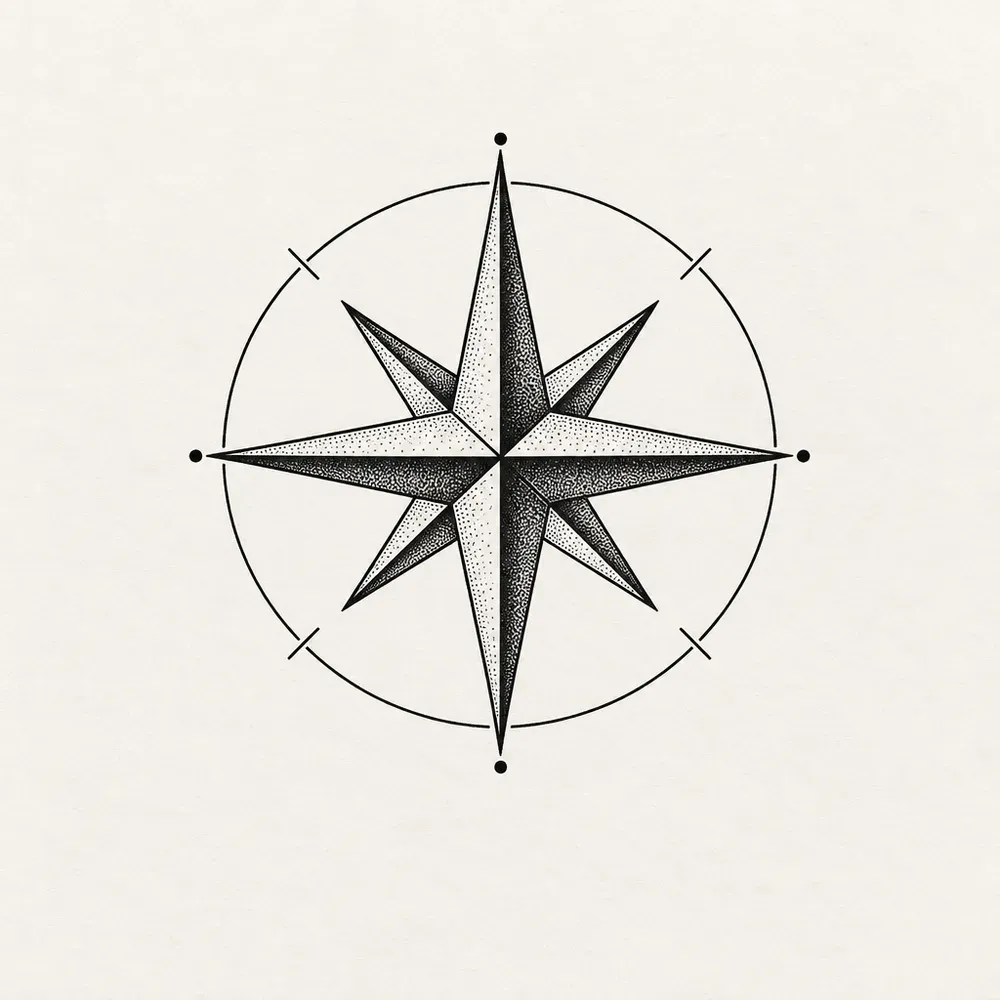 Classic rose Compass
  Nautical rope Compass
 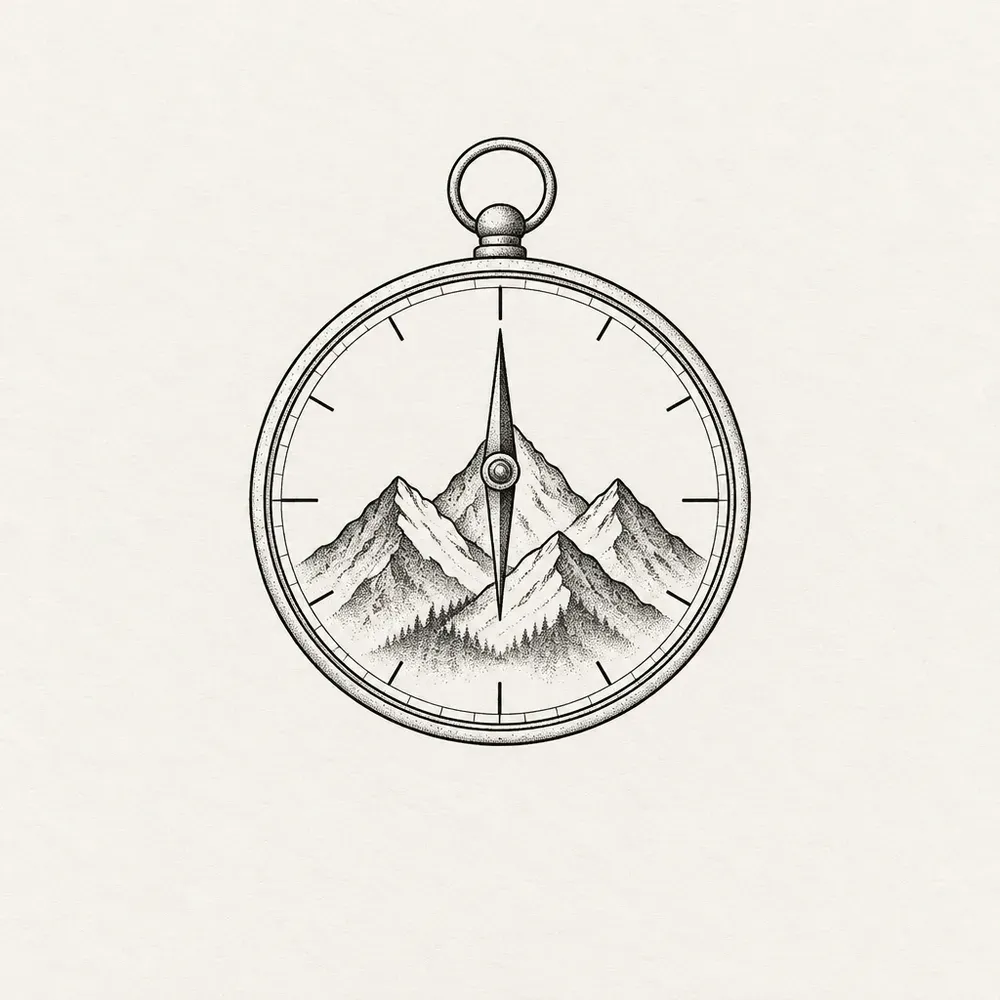 Mountains inside Compass
 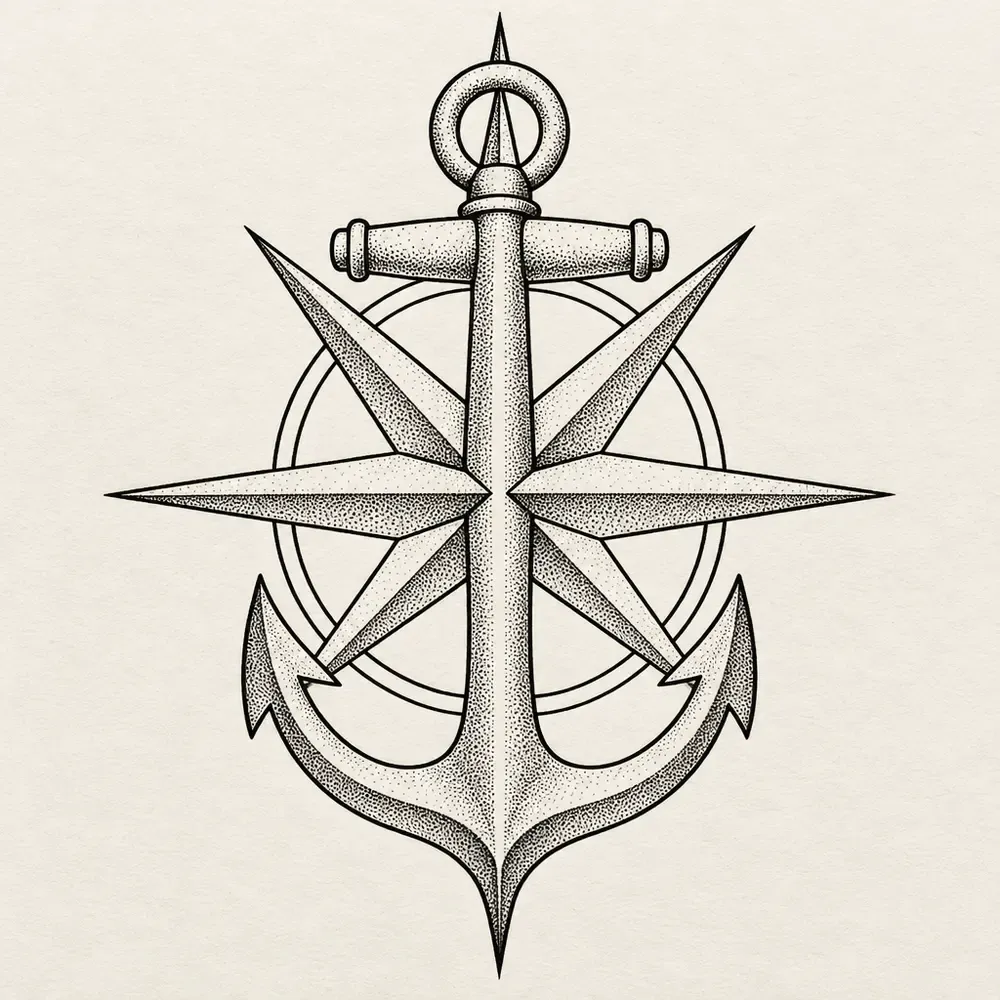 With an anchor Compass
 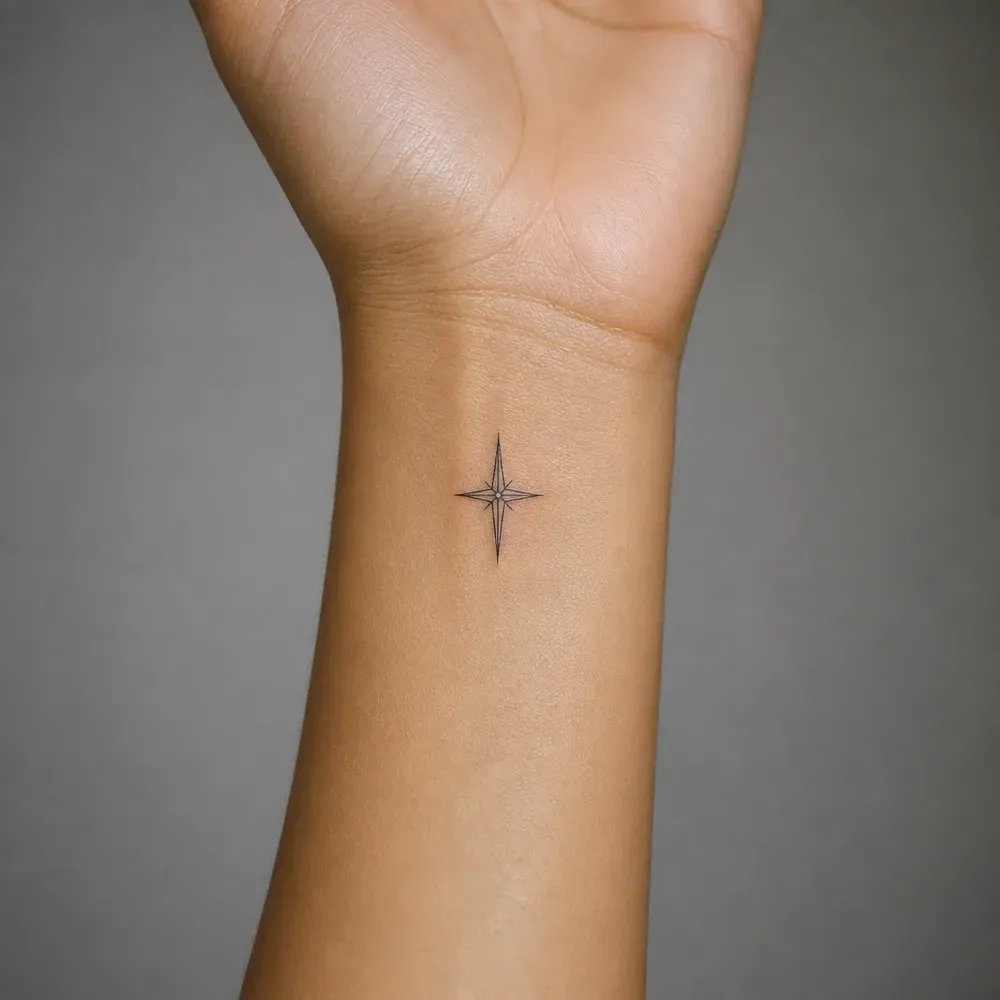 Minimal, on a wrist Compass
  Globe, on a thigh Compass
 Common questions
- What does a compass tattoo mean?
- Finding your way, and usually finding your way back. The compass rose comes from sea charts, where it showed a navigator the directions, and sailors wore it for a safe return home. Most people now wear it for direction in their own life: knowing where they are going, or getting back on course after a bad stretch.
- Is a compass tattoo a sailor tattoo?
- It started as one. The compass rose and its cousin the nautical star were part of the sailors' flash that most Western tattooing grew out of. Today it is worn far more by people who have never worked a ship, and the meaning has moved from the sea to life in general.
- What does a compass with mountains mean?
- Travel and the outdoors, usually, or a particular climb the wearer has done or means to do. There is no old tradition behind the pairing. It is a modern design, and the mountains say what you put them there for.
- What does a compass and anchor tattoo mean?
- Two sailor symbols with two different jobs. The compass is about direction and the anchor is about holding still. Together they are usually read as knowing where you are going and staying steady on the way, which is a modern reading built from two old marks.
- Does a compass tattoo have to point north?
- No. A compass rose is drawn with north at the top by convention, but a tattoo can turn the needle to anything. Some people point it at a hometown, a person or a date. If the needle points somewhere other than north, that choice is the meaning, so decide it before the drawing is done.
- What does a compass tattoo mean for a seafarer or someone working abroad?
- For Filipino seafarers and families of workers abroad it is often the plainest version of the old sailor reading: the way home. It is a modern use of the symbol and one of the most direct, because it is exactly what the compass was for.
Related guides
If you are in Luzon
The same artist who wrote none of the above runs a home tattoo service across Luzon: he brings the whole setup to your house and the kit stays sealed until it is opened in front of you. He covers Olongapo, Subic, Castillejos, San Marcelino, Bataan and Pampanga.
An enquiry that names the design idea, the placement, a rough size in centimetres and your town gets a proper answer. Transport is yours to pay on top of the tattoo, worked out from the distance and quoted with it.