Tattoo Symbols and Meanings: Which Ones Are Real
LOT 20260923 · NO 37/43 · 1254 WORDS · 6 MIN
Most symbol meanings are younger than they look. The ones that last are attached to a story the wearer can tell, and the test is whether you can say what it means without repeating the sentence you read.
Most of these meanings are younger than people think
There is a particular way symbol meanings get written down. A list says the lotus means rebirth, the next list copies it, and after forty repetitions it reads like something ancient. Some of it is ancient. A great deal of it was invented in the last thirty years by people writing lists.
That is worth knowing before you choose one, because the symbols with real weight are the ones with a traceable story, and the ones without are just shapes somebody assigned a word to. Below, where a meaning has a source, it is named. Where it does not, that is said too.
The useful test before you commit: can you say what it means to you in one sentence, without repeating a sentence you read? If not, it is the list’s meaning and not yours, and you will be explaining somebody else’s idea for the rest of your life.
Symbols with a traceable origin
The semicolon. A sentence the writer could have ended and chose to continue. It comes from Project Semicolon, founded in 2013, and it is worn for mental health, suicide loss and survival. One of the very few symbols here with a single documented origin and a date, which is exactly why it carries the weight it does. The semicolon, and where it began is the longer page, with the Philippine crisis lines on it.
Medusa. In the older telling she is a monster to be killed. In the retelling most people who wear her have in mind, she was punished for something done to her rather than something she did, and the tattoo is worn by survivors of assault as a refusal of that blame. The meaning is recent, the argument behind it is not, and either way it is a deliberate reading rather than a decoration. The medusa, and who she was gives the myth in both ancient versions and how the survivor reading took hold.
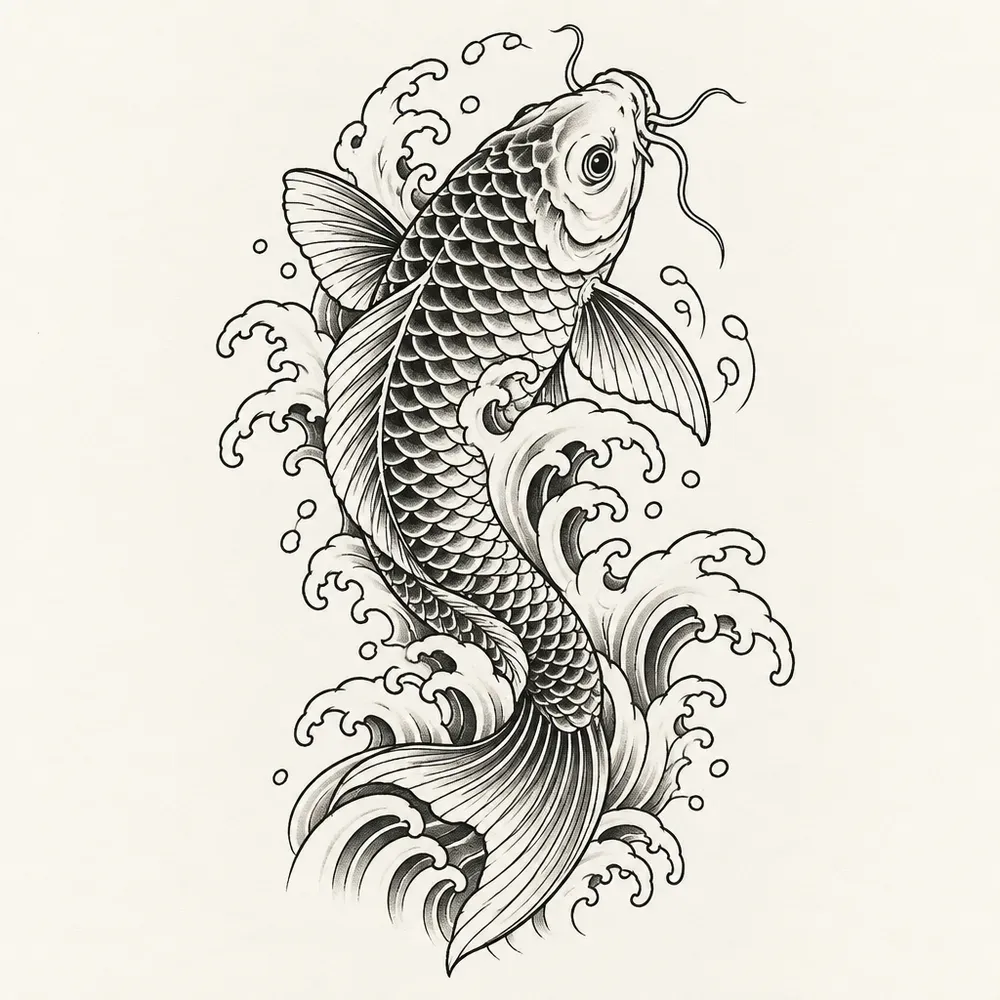
The koi. From the Chinese story of the carp that swims up the Yellow River and through the Dragon Gate, and becomes a dragon for having done it. Perseverance through something that was supposed to stop you. Carried into Japanese tattooing, where the direction it swims and the colour both carry additional meaning, which is why it is worth having drawn by somebody who knows the tradition rather than copied off a search result.
The lotus. Rooted in mud, flowering above it, closing at night and opening again. It is genuinely old and genuinely religious in Buddhism and Hinduism, and that is worth knowing rather than treating it as a pretty flower with a caption.
The hannya mask. A mask from Japanese Noh theatre, showing a woman transformed by jealousy and grief into something demonic. It is not a demon. The face is read as sad from one angle and furious from another, which is the whole point of the carving, and a good one keeps that.
The unalome. From Buddhist iconography: the winding line is the path before clarity, the straight section afterwards, the dot at the end the moment of reaching it. Frequently drawn upside down by people copying it from somewhere it was already upside down.
Symbols whose meaning has moved
These are the honest ones to be careful with, because the meaning changed inside living memory.
The swallow. Meant a sailor had covered five thousand nautical miles, or that he was near land. In parts of Britain and Australia it later meant a prison sentence served. Today it usually means neither and the wearer picks one. Three meanings in a century, which is the clearest example on this page of a symbol whose meaning lives in the time and not in the shape.
The snake. Shedding, rebirth and renewal in most readings. Temptation and danger in others, depending entirely on which tradition the reader grew up in. The same tattoo says two opposite things to two people, and there is no version that settles it.
The butterfly. Change, and specifically change you came out of different. Very widely worn, which does not weaken it, but does mean it says less about you than you may intend. The soul reading is old too, and here a butterfly in the house is a relative visiting: the butterfly, old readings and recent ones.
The moth. Often chosen as the butterfly’s darker sibling: drawn to light, associated with night and with transformation that costs something. A recent reading rather than an old one.
The compass and the anchor. Both nautical, both now general: find your way, stay grounded. The original meanings were literal and practical and the current ones are metaphors, which is a very normal way for a symbol to age. The compass, and where north is separates the sailor’s readings from the ones added since.
The rose. Love, in almost every reading, with the thorns as the price of it. Old, widely understood, and one of the few where the common meaning and the historical one still broadly agree.
Symbols people ask about that mean less than the lists claim
Geometric and mandala work. Beautiful, and largely chosen for how it looks. Mandalas are genuinely religious objects in Buddhism and Hinduism; the geometric style that borrows their shape usually is not, and claiming otherwise is where a meanings list starts inventing.
Roman numerals. A date. The meaning is entirely whose date it is, which makes it one of the most personal things on this page and one of the least symbolic.
Script and lettering. The meaning is the words. Worth saying because a lettering piece is where mistakes are permanent in a way a shape is not: check the spelling, check the language with somebody who actually speaks it, and check it again.
Baybayin, the pre-colonial Philippine script, is worth naming here for the same reason. It is a real writing system with real rules, it is frequently rendered wrong by people copying a chart, and a piece of permanent writing in a script neither of you reads is the worst possible place to guess.
Choosing one that will still mean something in ten years
The pattern in every symbol above that has lasted is the same: it is attached to a story the wearer can tell. The ones that fade are the ones chosen from a list of meanings, because a list is not a story and cannot become one later.
Three questions that are worth more than any meanings list:
- Can you say what it means to you without using the word the list used?
- Would you still want it if nobody ever asked about it?
- Does it need explaining to work? Something that only works as a conversation starter stops working once everybody has heard the conversation.
None of that decides the design. It decides whether you will still like the reason.
Before it is drawn
A meaning that matters is worth drawing properly. Bring the story rather than the symbol: an artist given “perseverance, and here is why” will draw something better than one given “a koi, please”, because the second is a search result and the first is yours.
Placement matters more than people expect for symbol work, because symmetrical symbols show every distortion when the body underneath them moves. Where it goes, and what that costs covers that. If it is your first, how much it hurts by placement is the other question worth settling first.
Two of the symbols this page takes apart, drawn as they would be tattooed.

Common questions
- What tattoo symbol means strength?
- The ones people usually choose are the lion, the phoenix, the koi swimming upstream and the unalome. None of them means strength by itself. They mean it because the story attached to each one is about surviving something, and that story is what you are actually wearing.
- What does a semicolon tattoo mean?
- A sentence the writer could have ended and chose to continue. It comes from Project Semicolon, started in 2013, and it is worn for mental health, suicide loss and survival. It is one of the few symbols with a single, traceable origin rather than centuries of drift.
- What does a medusa tattoo mean?
- In the older telling she is a monster. In the retelling most people who wear her have in mind, she was punished for what was done to her, and the tattoo is worn by survivors of assault as a refusal of that blame.
- Do tattoo symbols have fixed meanings?
- Almost none of them do. A swallow meant a sailor's distance covered, then a prison sentence served, and now usually means neither. The meaning lives in the wearer and the time, not in the shape.
- What is a good first tattoo with meaning?
- Something you can explain in one sentence without repeating something you read. If the explanation is a paraphrase of a meanings list, the meaning is the list's and not yours.
One symbol at a time
The same argument applied to one design, with the readings that are genuinely old marked off from the ones that were invented recently.
Related guides
If you are in Luzon
The same artist who wrote none of the above runs a home tattoo service across Luzon: he brings the whole setup to your house and the kit stays sealed until it is opened in front of you. He covers Olongapo, Subic, Castillejos, San Marcelino, Bataan and Pampanga.
An enquiry that names the design idea, the placement, a rough size in centimetres and your town gets a proper answer. Transport is yours to pay on top of the tattoo, worked out from the distance and quoted with it.